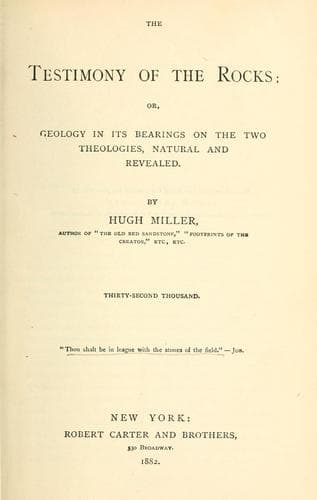
The Testimony of the Rocks: or, Geology in Its Bearings on the Two Theologies, Natural and RevealedMiller, Hugh
Philosophy
The Testimony of the Rocks: or, Geology in Its Bearings on the Two Theologies, Natural and Revealed
Miller, Hugh
Bible and geology; Creation; Religion and science
The Continental writers on this curious subject may be regarded as not
inadequately represented by Dr. J.H. Kurtz, Professor of Theology at
Dorpat,--one of the many ingenious biblical scholars of modern Germany.
We find him stating the question, in his _Bibel und Astronomie_ (second
edition, 1849), with great precision and clearness, but in a manner, so
far at least as the form of his thinking is concerned, strikingly
characteristic of what may be termed the theological fashion of his
country in the present day. "The source of all human history," he says,
"is _eye-witness_, be it that of the reporter, or of another whose
account has been handed down. Only what man has himself seen or
experienced can be the subject of man's historical compositions. So that
history, so far as man can write it, can begin with but the point at
which he has entered into conscious existence, and end with the moment
that constitutes the present time. Beyond these points, however, lies a
great province of historic development, existing on the one side as the
_Past_, on the other side as the _Future_. For when man begins to be an
observer or actor of history, he himself, and the whole circumstantials
of his condition, have already come historically into being. Nor does
the flow of development stop with what is his present. Millions of
influences are spinning the thread still on; but no one can tell what
the compound result of all their energies is to be. Both these sorts of
history, then, lie beyond the region of man's knowledge, which is shut
up in space and time, and can only call the present its own. It is God
alone who, standing beyond and above space and time, sees backwards and
forwards both the development which preceded the first _present_ of men,
and that which will succeed this our latest _present_. Whatever the
difference of the two kinds of history may be, they hold the same
position in relation both to the principle of the human ignorance and
the principle of the human knowledge. The principle of the ignorance is
man's condition as a creature; the principle of the knowledge is the
Divine knowledge; and the medium between ignorance and knowledge is
objectively Divine revelation, and subjectively prophetic vision by man,
in which he beholds with the eye of the mind what is shut and hid from
the eye of his body." From these premises Dr. Kurtz goes on to argue
that the pre-Adamic history of the past being _theologically_ in the
same category as the yet undeveloped history of the future, that record
of its leading events which occurs in the Mosaic narrative is simply
_prophecy_ described backwards; and that, coming under the prophetic
law, it ought of consequence to be subjected to the prophetic rule of
exposition. There are some very ingenious reasonings employed in
fortifying this point; and, after quoting from Eichhorn a passage to the
effect that the opening chapter in Genesis is much rather a creative
Public-domain text, read in full here on John Shaqi.
Reviews
Reviews
No reviews yet
Be the first to share your thoughts on this work.
Elsewhere in the archive
Join the Discussion
Join the discussion
Sign in to leave a comment or review.
Sign InorCreate an account