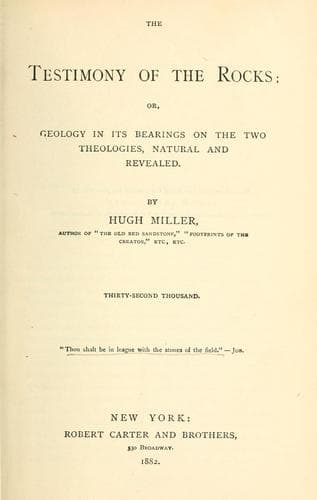
The Testimony of the Rocks: or, Geology in Its Bearings on the Two Theologies, Natural and RevealedMiller, Hugh
Philosophy
The Testimony of the Rocks: or, Geology in Its Bearings on the Two Theologies, Natural and Revealed
Miller, Hugh
Bible and geology; Creation; Religion and science
Nor, be it remembered, has the recognition of a purely _optical_
character in the revelation been restricted to the assertion of any one
theory of reconciliation. It was as certainly held by Chalmers and Dr.
Pye Smith, as by Dr. Kurtz and the author of this treatise; nay, it has
been recognized by not a few of their opponents also. Granville Penn,
for instance, does not scruple to avow his belief, in his elaborate
"Estimate of the Mineral and Mosaic Geologies," that both sun and moon
were created on the first day of creation, though they did not become
"_optically_ visible" until the fourth. "In truth, that the fourth day
only rendered visible the sidereal creation of the first day, is
manifested," he says, "by collating the transactions of the two days. On
the first day, we are told generally, 'God divided the light, or day,
and the darkness, or night;' but the physical agents which he employed
for that division are not there declared. On the fourth day, we are told
referentially, 'God commanded the lights [or luminaries] for dividing
day and night, to give their light upon earth.' Here, then, it is
evident from the retrospective implication of the latter description,
that the lights or luminaries for dividing day and night, which were to
give their light upon the earth for the first time on the fourth day,
were the unexpressed physical agents by which God divided the day and
night on the first day." Now, whatever may be thought of Mr. Penn's
argument here, there can be no doubt that it demonstrates at least his
own belief in the purely optical character of the Mosaic account of the
sidereal creation. It is an account, he held, not of what God wrought on
the first day in the heavens, but of what a human eye would have seen on
the fourth day from the earth. And Moses Stuart, in his philological
assault on the geologists, is scarce less explicit in his avowal of a
similar belief. "Every one sees," he says, "that to speak of the sun as
rising and setting, is to describe, in common parlance, what appears
_optically_, that is, to our sensible view, as reality. But the history
of creation is a different affair. In ONE RESPECT, indeed, there is a
resemblance. _The historian everywhere speaks as an optical observer
stationed on a point of our world, and surveying from this the heavens
and the earth, and speaking of them as seen in this manner by his bodily
eye._ The sun, and moon, and stars, are servants of the earth, lighted
up to garnish and to cheer it, and to be the guardians of its times and
seasons. Other uses he knows not for them: certainly of other uses he
does not speak. The distances, magnitudes, orbicular motions,
gravitating powers, and projectile forces of the planets and of the
stars, are all out of the circle of his history, and probably beyond his
knowledge. Inspiration does not make men _omniscient_. It does not teach
them the scientific truths of astronomy, or chemistry, or botany, nor
any science as such.
Public-domain text, read in full here on John Shaqi.
Reviews
Reviews
No reviews yet
Be the first to share your thoughts on this work.
Elsewhere in the archive
Join the Discussion
Join the discussion
Sign in to leave a comment or review.
Sign InorCreate an account