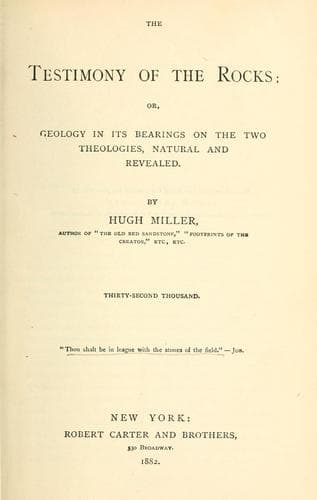
The Testimony of the Rocks: or, Geology in Its Bearings on the Two Theologies, Natural and RevealedMiller, Hugh
Philosophy
The Testimony of the Rocks: or, Geology in Its Bearings on the Two Theologies, Natural and Revealed
Miller, Hugh
Bible and geology; Creation; Religion and science
_prophecies_ that referred to events _anterior_ to his time? In what
light, or on what principle, shall we most correctly read the prophetic
drama of creation? In the light, I reply, of scientific discovery,--on
the principle that the clear and certain must be accepted, when
attainable, as the proper exponents of the doubtful and obscure. What
fully developed history is to the prophecy which of old looked forwards,
fully developed science is to the prophecy which of old looked
backwards. Scarce any one will question whether that portion of the
creation drama which deals with the heavenly bodies ought to be read in
the light of established astronomic discovery or no; for, save by
perhaps a few of Father Cullen's monks, who can still hold that the sun
moves round the earth, and is only six feet in diameter, all theologians
have now received the astronomic doctrines, and know that they rest upon
a basis at least as certain as any of the historic events symbolized in
fulfilled prophecy. And were we to challenge for the established
geologic doctrines a similar place and position with respect to those
portions of the drama which deal with the two great kingdoms of nature,
plant and animal, we might safely do so in the belief that the claim
will be one day as universally recognized as the astronomic one is now.
On this principle there may, of course, be portions of the _prophetic_
pre-Adamic past of as doubtful interpretation at the present time, from
the imperfect development of physical science, as is any portion of the
prophetic future from the imperfect development of historic events. The
science necessary to the interpretation of the one may be as certainly
still to discover as the events necessary to the interpretation of the
other may be still to take place. Three centuries have not yet passed
since astronomic science was sufficiently developed to form a true key
to the various notices of the heavenly bodies which occur in Scripture;
among the others, to the notice of their final appearance on the
_fourth_ day of creation. Little more than half a century has yet passed
since geologic science was sufficiently developed to influence the
interpretation given of the three _other_ days' work. And respecting the
work of at least the first and second days, more especially that of the
second, we can still but vaguely guess. The science necessary to the
right understanding of these portions of the prophetic record has still,
it would seem, to be developed, if, indeed, it be destined at all to
exist; and at present we can indulge in but doubtful surmises regarding
them. What may be termed the three _geologic_ days,--the third, fifth,
and sixth,--may be held to have extended over those Carboniferous
periods during which the great plants were created,--over those Oolitic
and Cretacious periods during which the great sea monsters and birds
were created,--and over those Tertiary periods during which the great
terrestrial mammals were created.
Public-domain text, read in full here on John Shaqi.
Reviews
Reviews
No reviews yet
Be the first to share your thoughts on this work.
Elsewhere in the archive
Join the Discussion
Join the discussion
Sign in to leave a comment or review.
Sign InorCreate an account