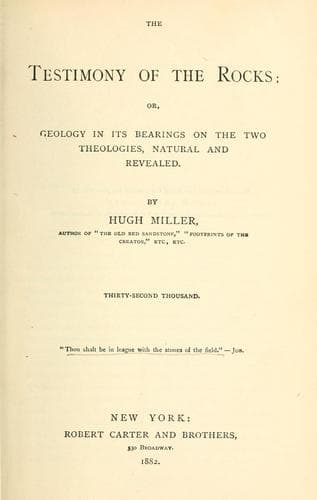
The Testimony of the Rocks: or, Geology in Its Bearings on the Two Theologies, Natural and RevealedMiller, Hugh
Philosophy
The Testimony of the Rocks: or, Geology in Its Bearings on the Two Theologies, Natural and Revealed
Miller, Hugh
Bible and geology; Creation; Religion and science
The statement of Dr. Kurtz, that as vision of pre-Adamic history comes
under the same laws as vision of history still future, it ought
therefore to be read by the same rules, craves reflection. "Since the
source of knowledge for both kinds of history," we find him saying, "and
not only the source, but the means, and manner, and way of coming to
know, is the same, viz., the _eye-witness_ of the prophet's mental eye,
it follows that the historical representation which he who thus comes to
know, _projects_ [or portrays], in virtue of this eye-witnessing of his,
holds the same relation to the reality in both the cases we speak of,
and must be subjected to the same laws of exposition. We thus get this
very important rule of interpretation, viz., that the representations of
pre-human events, which rest upon revelation, are to be handled from the
same point of view, and expounded by the same laws, as the prophecies
and representations of future times and events, which also rest upon
revelation. This, then, is the only proper point of view for scientific
exposition of the Mosaic history of creation; that is to say, if we
acknowledge that it proceeded from Divine revelation, not from
philosophic speculation or experimental investigation, or from the ideas
of reflecting men." There is certainly food for thought in this striking
and original view; and there is at least one simple rule of prophetic
exposition which may be applied to the pre-Adamic history, in accordance
with the principle which it suggests. After all that a scientific
theology has done for the right interpretation of prophecy, we find the
prediction always best read by the light of its accomplishment. The
event which it foretold forms its true key; and when this key is
wanting, all is uncertainty. The past is comparatively clear. The
hieroglyphic forms which crowd the anterior portions of the prophetic
tablet are found wonderfully to harmonize (men such as the profound
Newton being the judges) with those great historic events, already
become matter of history, which they foreshadowed and symbolized; but,
on the other hand, the hieroglyphics which occupy the tablet's
posterior portion,--the hieroglyphics that symbolize events still
future,--are invincibly difficult and inexplicable. I have read several
works on prophecy produced in the last age, in which the writers were
bold enough to quit the clue with which history furnishes the student of
fulfilled prophecy, and, with the prophecies yet unfulfilled as their
guide, to plunge into a troubled sea of speculation regarding the
history of the future. And I have found that in every instance they were
deplorably at fault regarding even the events that were nearest at hand
at the time. History is thus the surest interpreter of the revealed
prophecies which referred to events _posterior_ to the times of the
prophet. In what shall we find the surest interpretation of the revealed
Public-domain text, read in full here on John Shaqi.
Reviews
Reviews
No reviews yet
Be the first to share your thoughts on this work.
Elsewhere in the archive
Join the Discussion
Join the discussion
Sign in to leave a comment or review.
Sign InorCreate an account