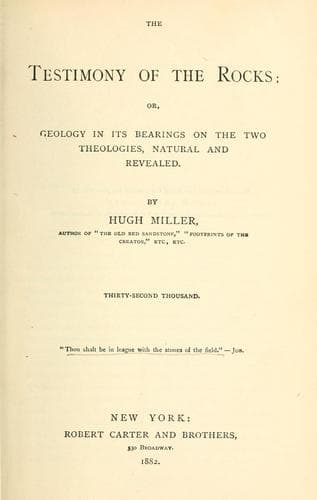
The Testimony of the Rocks: or, Geology in Its Bearings on the Two Theologies, Natural and RevealedMiller, Hugh
Philosophy
The Testimony of the Rocks: or, Geology in Its Bearings on the Two Theologies, Natural and Revealed
Miller, Hugh
Bible and geology; Creation; Religion and science
our present atmosphere, would wrap up the earth in a darkness gross and
palpable as that of Egypt of old,--a darkness through which even a
single ray of light would fail to penetrate. And beneath this thick
canopy the unseen deep would literally "boil as a pot," wildly tempested
from below; while from time to time more deeply seated convulsion would
upheave sudden to the surface vast tracts of semi-molten rock, soon
again to disappear, and from which waves of bulk enormous would roll
outwards, to meet in wild conflict with the giant waves of other
convulsions, or return to hiss and sputter against the intensely heated
and fast foundering mass, whose violent upheaval had first elevated and
sent them abroad. Such would be the probable state of things during the
times of the earlier gneiss and mica schist deposits,--times buried deep
in that chaotic night or "evening" which must have continued to exist
for mayhap many ages after that beginning of things in which God created
the heavens and the earth, and which preceded the first day. To a human
eye stationed within the cloud, all, as I have said, must have been
thick darkness: to eyes Divine, that could have looked through the
enveloping haze, the appearance would have been that described by
Milton, as seen by angel and archangel at the beginning of creation,
when from the gates of heaven they looked down upon chaos:--
"On heavenly ground they stood, and from the shore
They viewed the vast immeasurable abyss,
Outrageous as a sea, dark, wasteful, wild,
Up from the bottom turned by furious _heat_
And surging waves, as mountains to assault
Heaven's height, and with the centre mix the pole."
At length, however, as the earth's surface gradually cooled down, and
the enveloping waters sunk to a lower temperature,--let us suppose,
during the latter times of the mica schist, and the earlier times of the
clay slate,--the steam atmosphere would become less dense and thick, and
at length the rays of the sun would struggle through, at first
doubtfully and diffused, forming a faint twilight, but gradually
strengthening as the latter ages of the slate formation passed away,
until, at the close of the great primary period, day and night,--the one
still dim and gray, the other wrapped in a pall of thickest
darkness,--would succeed each other as now, as the earth revolved on its
axis, and the unseen luminary rose high over the cloud in the east, or
sunk in the west beneath the undefined and murky horizon. And here again
the _optical_ appearance would be exactly that described by Milton:--
Public-domain text, read in full here on John Shaqi.
Reviews
Reviews
No reviews yet
Be the first to share your thoughts on this work.
Elsewhere in the archive
Join the Discussion
Join the discussion
Sign in to leave a comment or review.
Sign InorCreate an account