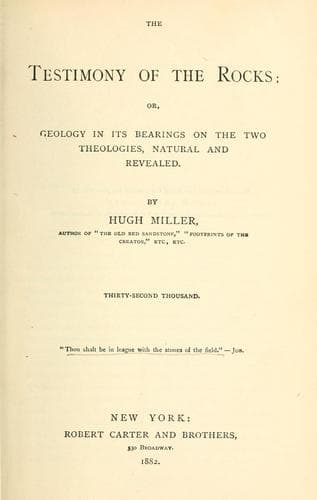
The Testimony of the Rocks: or, Geology in Its Bearings on the Two Theologies, Natural and RevealedMiller, Hugh
Philosophy
The Testimony of the Rocks: or, Geology in Its Bearings on the Two Theologies, Natural and Revealed
Miller, Hugh
Bible and geology; Creation; Religion and science
"'Let there be light,' said God, and forthwith light
Ethereal, first of things, quintessence pure,
Sprung from the deep, and from her native east
To journey through the airy gloom began,
Sphered in a radiant cloud, for yet the sun
Was not: she in a cloudy tabernacle
Sojourned the while. God saw the light was good,
And light from darkness by the hemisphere
Divided: light the day, and darkness night,
He named. This was the first day, even and morn."
The second day's work has been interpreted variously, according to the
generally received science of the times of the various commentators who
have dealt with it. Even in Milton, though the great poet rejected the
earlier idea of a solid firmament, we find prominence given to that of a
vast hollow sphere of "circumfluous waters," which, by encircling the
atmosphere, kept aloof the "fierce extremes of chaos." Later
commentators, such as the late Drs. Kitto and Pye Smith, hold that the
Scriptural analogue of the _firmament_ here--by the way, a Greek, not a
Hebrew idea, first introduced into the Septuagint--was in reality simply
the atmosphere with its clouds. "The historian" [Moses], says Dr. Kitto,
"speaks as things would have appeared to a spectator at the time of the
creation. A portion of the heavy watery vapor had flown into the upper
regions, and rested there in dense clouds, which still obscured the sun;
while below, the whole earth was covered with water. Thus we see the
propriety with which the firmament is said to have divided the waters
from the waters." It is certainly probable that in a vision of creation
the atmospheric phenomena of the second great act of the creation drama
might have stood out with much greater prominence to the prophetic eye
placed in the circumstances of a natural one, than any of its other
appearances. The invertebrate life of the Silurian period, or even the
ichthyic life of the earlier Old Bed Sandstone period, must have been
comparatively inconspicuous from any sub-ærial point of view elevated
but a few hundred feet over the sea level. Even the few islets of the
latter ages of the period, with their ferns, lepidodendra, and
coniferous trees, forming, as they did, an exceptional feature in these
ages of vast oceans, and of organisms all but exclusively marine, may
have well been excluded from a representative diorama that exhibited
optically the grand characteristics of the time. Further, it seems
equally probable that the introduction of organized existence on our
planet was preceded by a change in the atmospheric conditions which had
obtained during the previous period, in which the earth had been a
desert and empty void. We know that just before the close of the
Silurian ages terrestrial plants had appeared, and that before the close
of the Old Red Sandstone ages, air-breathing animals had been produced;
and infer that the atmosphere in which both could have existed must have
been considerably different from that which lay dark and heavy over the
Public-domain text, read in full here on John Shaqi.
Reviews
Reviews
No reviews yet
Be the first to share your thoughts on this work.
Elsewhere in the archive
Join the Discussion
Join the discussion
Sign in to leave a comment or review.
Sign InorCreate an account