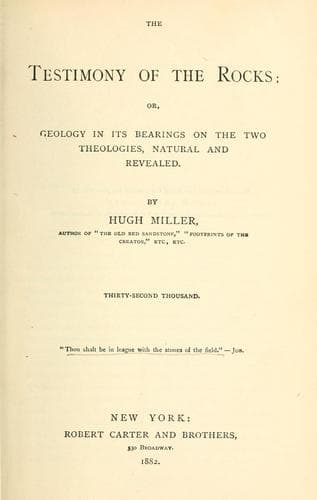
The Testimony of the Rocks: or, Geology in Its Bearings on the Two Theologies, Natural and RevealedMiller, Hugh
Philosophy
The Testimony of the Rocks: or, Geology in Its Bearings on the Two Theologies, Natural and Revealed
Miller, Hugh
Bible and geology; Creation; Religion and science
days as given points in the problem, of being treated geologically.
Another of the questions raised, both by the German doctor and the
writer in our own country, must be recognized as eminently suggestive.
"We treat the history of creation," says Dr. Kurtz, "with its six days'
work, as a connected series of so many prophetic visions. The appearance
and evanishing of each such vision seem to the seer as a morning and an
evening, apparently because these were presented to him as an increase
and decrease of light, like morning and evening twilight." And we find
the Scottish writer taking essentially the same view. "Each day
contains," he says, "the description of what he [Moses] beheld in a
single vision, and when it faded it was twilight. There is nothing
forced in supposing that, after the vision had for a time illumined the
fancy of the seer, it was withdrawn from his eyes, in the same way that
the landscape becomes dim on the approach of evening.... From this point
of view, a 'day' can only mean the period during which the Divinely
enlightened fancy of the seer was active. When all continued bright and
manifest before his entranced but still conscious soul, it was 'day' or
'light.' When the dimness of departing enlightenment fell upon the
scene, it was the evening twilight." The _days_, then, are removed, we
find, by the holders of this view, altogether from the province of
chronology to the province of prophetic vision; they are represented
simply as parts of the exhibited scenery, or rather as forming the
measures of the apparent time during which the scenery _was_ exhibited.
We must also hold, however, that in the character of symbolic days they
were as truly representative of the lapse of foregone periods of
creation as the scenery itself was representative of the creative work
accomplished in these periods. For if the apparent days occurred in only
the vision, and were not symbolic of foregone periods, they could not
have been transferred with any logical propriety from the vision itself
to that which the vision represented, as we find done in what our
Shorter Catechism terms "the reason annexed to the Fourth
Commandment."[18] The days must have been prophetic days, introduced,
indeed, into the panorama of creation as mayhap mere openings and
droppings of the curtain, but not the less symbolic of that series of
successive periods, each characterized by its own productions and
events, in which creation itself was comprised. Nothing more probable,
however, than that even Moses himself may have been unacquainted with
the _extent_ of the periods represented in the vision; nay, he may have
been equally unconscious of the actual extent of the seeming days by
which they were symbolized. "Visions without dark speeches,"--visions,
not of symbolic apparitions, but of actual existences and events, past
or present,--may, nay must, have differed from what may be termed the
dark hieroglyphic visions; but we find in all visions an element of mere
Public-domain text, read in full here on John Shaqi.
Reviews
Reviews
No reviews yet
Be the first to share your thoughts on this work.
Elsewhere in the archive
Join the Discussion
Join the discussion
Sign in to leave a comment or review.
Sign InorCreate an account