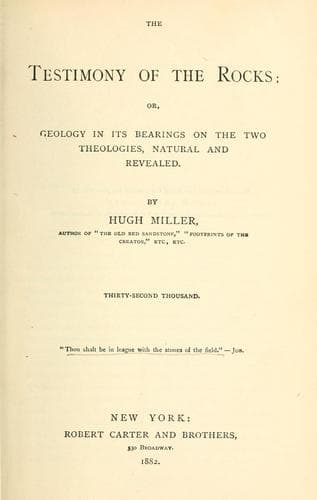
The Testimony of the Rocks: or, Geology in Its Bearings on the Two Theologies, Natural and RevealedMiller, Hugh
Philosophy
The Testimony of the Rocks: or, Geology in Its Bearings on the Two Theologies, Natural and Revealed
Miller, Hugh
Bible and geology; Creation; Religion and science
with mayhap a little more of cloud and moisture, and a great deal more
of heat. The earth would have been a vast greenhouse covered with smoked
glass; and a vigorous though mayhap loosely knit and faintly colored
vegetation would have luxuriated under its shade.
The fifth and sixth days,--that of winged fowl and great sea monsters,
and that of cattle and beasts of the earth,--I must regard as adequately
represented by those Secondary ages, Oolitic and Cretaceous, during
which birds were introduced, and reptiles received their greatest
development, and those Tertiary ages during which the gigantic mammals
possessed the earth and occupied the largest space in creation. To the
close of this latter period,--the evening of the sixth day,--man
belongs,--at once the last created of terrestrial creatures, and
infinitely beyond comparison the most elevated in the scale; and with
man's appearance on the scene the days of creation end, and the Divine
Sabbath begins,--that Sabbath of rest from creative labor of which the
proper work is the moral development and elevation of the species, and
which will terminate only with the full completion of that sublime task
on the full accomplishment of which God's eternal purposes and the
tendencies of man's progressive nature seem alike directed. Now, I am
greatly mistaken if we have not in the six geologic periods all the
elements, without misplacement or exaggeration, of the Mosaic drama of
creation.
I have referred in my brief survey to extended periods. It is probable,
however, that the prophetic vision of creation, if such was its
character, consisted of only single representative scenes, embracing
each but a point of time; it was, let us suppose, a diorama, over whose
shifting pictures the curtain rose and fell six times in
succession,--once during the Azoic period, once during the earlier or
middle Palæozoic period, once during the Carboniferous period, once
during the Permian or Triassic period, once during the Oolitic or
Cretaceous period, and finally, once during the Tertiary period. Dr.
Kurtz holds, taking the Sabbath into the series, that the division into
_seven_ scenes or stages may have been regulated with reference to the
importance and sacredness of the mythic number seven,--the symbol of
completeness or perfection; but the suggestion will perhaps not now
carry much weight among the theologians of Britain, whatever it might
have done two centuries ago. It is true, that creation _might_ have been
exhibited, not by seven, but by seven hundred, or even by seven thousand
scenes; and that the accomplished man of science, skilled in every
branch of physics, might have found something distinct in them all. But
not the less do the seven, or rather the six, exhibited scenes appear to
be not symbolic or mystical, at least not exclusively symbolic or
mystical, but truly representative of successive periods, strongly
distinctive in their character, and capable, with the three geologic
Public-domain text, read in full here on John Shaqi.
Reviews
Reviews
No reviews yet
Be the first to share your thoughts on this work.
Elsewhere in the archive
Join the Discussion
Join the discussion
Sign in to leave a comment or review.
Sign InorCreate an account