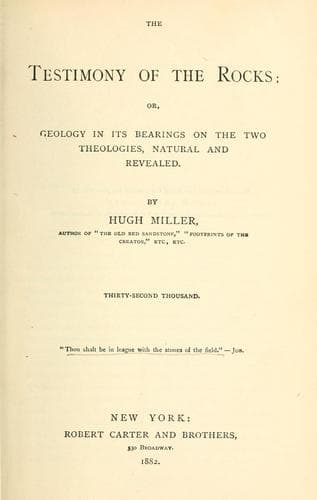
The Testimony of the Rocks: or, Geology in Its Bearings on the Two Theologies, Natural and RevealedMiller, Hugh
Philosophy
The Testimony of the Rocks: or, Geology in Its Bearings on the Two Theologies, Natural and Revealed
Miller, Hugh
Bible and geology; Creation; Religion and science
possessed of ten infinities of fingers and toes is in no respect an
absurdity. Of the three infinities possible in space, the second is
infinitely greater than the first, and the third infinitely greater than
the second. A line infinitely produced is capable of being divided
into--that is, consists of--an infinity of given parts; a plane
infinitely extended is capable of being divided into an infinity of
infinitely divisible lines; and a cube, that is, a solid, infinitely
expanded, is capable of being divided into an infinity of infinitely
divisible planes. In fine, metaphysic theology furnishes no argument
against the infinite series of the atheist. But geology does. Every
plant and animal that now lives upon earth began to be during the great
Tertiary period, and had no place among the plants and animals of the
great Secondary division. We can trace several of our existing
quadrupeds, such as the badger, the hare, the fox, the red deer, and the
wild cat, up till the earlier times of the Pleistocene; and not a few of
our existing shells, such as the great pecten, the edible oyster, the
whelk, and the Pelican's-foot shell, up till the greatly earlier times
of the Coraline Crag. But at certain definite lines in the deposits of
the past, representative of certain points in the course of time, the
existing mammals and molluscs cease to appear, and we find their places
occupied by other mammals and molluscs. Even such of our British shells
as seem to have enjoyed as species the longest term of life cannot be
traced beyond the times of the Pliocene deposits. We detect their
remains in a perfect state of keeping in almost every shell-bearing bed,
till we reach the Red and Coraline Crags, where we find them for the
last time; and, on passing into older and deeper lying beds, we see
their places taken by other shells, of species altogether distinct. The
very common shell _Purpura lapillus_, for instance, is found in our
raised beaches, in our Clyde beds, in our boulder clays and
mammaliferous crags, and, finally, in the Red Crag, beyond which it
fails to appear. And such also is the history of the common edible
mussel and common periwinkle; whereas the common edible cockle, and
common edible pecten (_P. opercularis_) occur not only in all these
successive beds, but in the Coral Crag also. They are older by a whole
deposit than their present contemporaries, the mussel and periwinkle;
and these, in turn, seem of older standing than shells such as _Murex
erinaceus_, that has not been traced beyond the times of the
mammaliferous crag, or than shells such as _Scrobicularia piperata_,
that has not been detected in more ancient deposits than raised sea
beaches of the later periods, and the elevated bottoms of old estuaries
and lagoons. We thus know, that in certain periods, nearer or more
remote, all our existing molluscs _began_ to exist, and that they had no
existence during the previous periods; which were, however, richer in
Public-domain text, read in full here on John Shaqi.
Reviews
Reviews
No reviews yet
Be the first to share your thoughts on this work.
Elsewhere in the archive
Join the Discussion
Join the discussion
Sign in to leave a comment or review.
Sign InorCreate an account