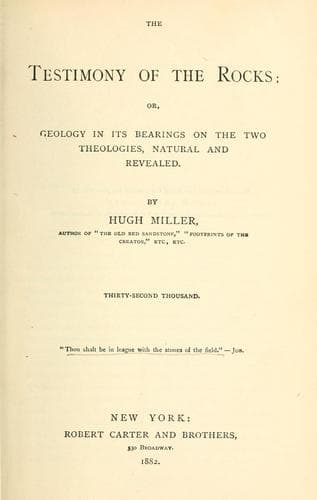
The Testimony of the Rocks: or, Geology in Its Bearings on the Two Theologies, Natural and RevealedMiller, Hugh
Philosophy
The Testimony of the Rocks: or, Geology in Its Bearings on the Two Theologies, Natural and Revealed
Miller, Hugh
Bible and geology; Creation; Religion and science
animals of the same great molluscan group than the present time. Our
British group of recent marine shells falls somewhat short of _four_
hundred species;[19] whereas the group characteristic of the older
Miocene deposits, largely developed in those districts of France which
border on the Bay of Biscay, and more sparingly in the south of England,
near Yarmouth, comprises more than six hundred species. Nearly an equal
number of still older shells have been detected in a single deposit of
the Paris basin,--the _Calcaire grossier_; and a good many more in a
more ancient formation still, the London Clay. On entering the Chalk, we
find a yet older group of shells, wholly unlike any of the preceding
ones; and in the Oolite and Lias yet other and different groups. And
thus group preceded group throughout all the Tertiary, Secondary, and
Palæozoic periods; some of them remarkable for the number of species
which they contained, others for the profuse abundance of their
individual specimens, until, deep in the rocks at the base of the
Silurian system, we detect what seems to be the primordial group,
beneath which only a single animal organism is known to occur,--the
_Oldhamia antiqua_,--a plant-like zoophyte, akin apparently to some of
our recent sertularia, (See fig. 5, page 48.) Each of the extinct groups
had, we find, a beginning and an end;--there is not in the wide domain
of physical science a more certain fact; and every species of the group
which now exists had, like all their predecessors on the scene, their
beginning also. The "infinite series" of the atheists of former times
can have no place in modern science: all organic existences, recent or
extinct, vegetable or animal, have had their beginning;--there was a
time when they were not. The geologist can indicate that time, if not by
years, at least by periods, and show what its relations were to the
periods that went before and that came after; and as it is equally a
recognized truth on both sides of the controversy, that as something now
exists, something must have existed forever, and as it must now be not
less surely recognized, that that something was not the race of man, nor
yet any other of the many races of man's predecessors or contemporaries,
the question, What then was that something? comes with a point and
directness which it did not possess at any former time. By what, or
through whom, did these races of nicely organized plants and animals
begin to be? Hitherto at least there has been but one reply to the
question originated on the skeptical side. All these races, it is said,
have been _developed_, in the long course of ages, into what they now
are, as the young animal is developed in the womb, or the young plant is
developed from the seed. Topsy, in the novel, "'spected that she was not
made, but growed;" and the only class of opponents which the geological
theist finds in the field which his science has laid open to the world
is a class that hold by the philosophy of Topsy.
Public-domain text, read in full here on John Shaqi.
Reviews
Reviews
No reviews yet
Be the first to share your thoughts on this work.
Elsewhere in the archive
Join the Discussion
Join the discussion
Sign in to leave a comment or review.
Sign InorCreate an account