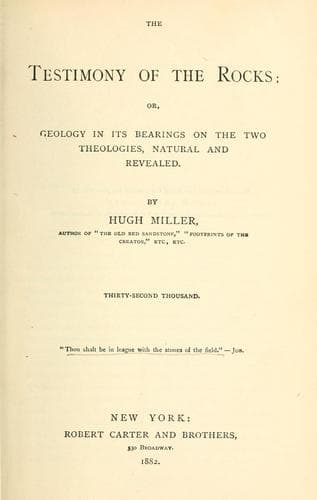
The Testimony of the Rocks: or, Geology in Its Bearings on the Two Theologies, Natural and RevealedMiller, Hugh
Philosophy
The Testimony of the Rocks: or, Geology in Its Bearings on the Two Theologies, Natural and Revealed
Miller, Hugh
Bible and geology; Creation; Religion and science
But while no hypothesis of development can neutralize or explain away
the great geologic fact, that every true species had a beginning
independently, apparently, of every preceding species, there was
demonstrably a general progress, in the course of creation, from lower
to higher forms, which seems scarce less fraught with important
consequences to the natural theologian than this fact of _beginning_
itself. For while the one fact effectually disposes of the "infinite
series" of the atheist, the other fact disposes scarce less effectually
of those reasonings on the skeptical side which, framed on the
assumption that creation is a "singular effect,"--an effect without
duplicate,--have been employed in urging, that from that one effect only
can we know aught regarding the producing cause. Knowing of the cause
from but the effect, and having experience of but one effect, we cannot
rationally hold, it has been argued, that the producing cause could have
originated effects of a higher or more perfect kind. The creation which
it produced we know; but, having no other measure of its power, we
cannot regard it, it has been contended, as equal to the production of a
better or nobler creation, or of course hold that it _could_ originate
such a state of things as that perfect future state which faith
delights to contemplate. It has been well said of the author of this
ingenious argument,--by far the most sagacious of the skeptics,--that if
we admit his premises we shall find it difficult indeed to set aside his
conclusions. And how, in this case, does geology deal with his premises?
By opening to us the history of the remote past of our planet, and
introducing us, through the present, to former creations, it breaks down
that _singularity_ of effect on which he built, and for one creation
gives us many. It gives us exactly that which, as he truly argued, his
contemporaries had not,--an _experience_ in creations. And let us mark
how, applied to each of these in succession, his argument would tell.
Public-domain text, read in full here on John Shaqi.
Reviews
Reviews
No reviews yet
Be the first to share your thoughts on this work.
Elsewhere in the archive
Join the Discussion
Join the discussion
Sign in to leave a comment or review.
Sign InorCreate an account