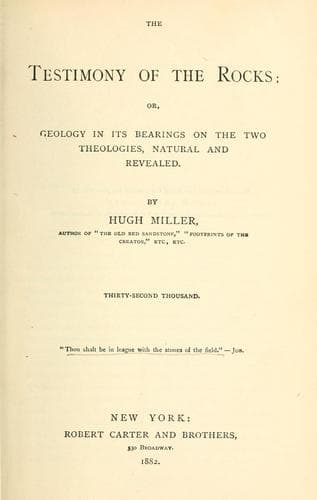
The Testimony of the Rocks: or, Geology in Its Bearings on the Two Theologies, Natural and RevealedMiller, Hugh
Philosophy
The Testimony of the Rocks: or, Geology in Its Bearings on the Two Theologies, Natural and Revealed
Miller, Hugh
Bible and geology; Creation; Religion and science
animals were developed out of previously existing plants and animals of
species entirely different, he affirms what, if true, _would_ be capable
of proof; and so, if it cannot be proven, it is only because it is not
true. The trilobites have been extinct ever since the times of the
Mountain Limestone; and yet, by series of specimens, the individual
development of certain species of this family, almost from the extrusion
of the animal from the egg until the attainment of its full size, has
been satisfactorily shown. By specimen after specimen has every stage of
growth and every degree of development been exemplified; and the
Palæontologist has come as thoroughly to know the creatures, in
consequence, under their various changes from youth to age, as if they
had been his contemporaries, and had grown up under his eye. And had our
existing species, vegetable and animal, been derived from other species
of the earlier periods, it would have been equally possible to
demonstrate, by a series of specimens, _their_ relationship. Let us
again instance the British shells. Losing certain species in each of the
older and yet older deposits at which we successively arrive, we at
length reach the Red and Coraline Crags, where we find, mingled with the
familiar forms, a large per centage of forms now extinct; then going on
to the shells of the lower Miocene, more than six hundred species
appear, almost all of which are strange to us; and then, passing to the
Eocene shells of the _Calcaire grossier_, we find ourselves among well
nigh as large a group of yet other and older strangers, not one of which
we are able to identify with any shell now living in the British area.
There would be thus no lack of materials for forming such a genealogy of
the British shells, had they been gradually developed out of the extinct
species, as that which M. Barrande has formed of the trilobites. But no
such genealogy can be formed. We cannot link on a single recent shell to
a single extinct one. _Up_ to a certain point we find the recent shells
exhibiting all their present specific peculiarities, and beyond that
point they cease to appear. _Down_ to a certain point the extinct shells
also exhibit all _their_ specific peculiarities, and then they disappear
forever. There are no intermediate species,--no connecting links,--no
such connected series of specimens to be found as enables us to trace a
trilobite through all its metamorphoses from youth to age. All geologic
history is full of the beginnings and the ends of species,--of their
first and their last days; but it exhibits no genealogies of
development. The Lamarckian sets himself to grapple, in his dream, with
the history of all creation: we awaken him, and ask him to grapple,
instead, with the history of but a few individual species,--with that of
the mussel or the whelk, the clam or the oyster; and we find from his
helpless ignorance and incapacity what a mere pretender he is.
Public-domain text, read in full here on John Shaqi.
Reviews
Reviews
No reviews yet
Be the first to share your thoughts on this work.
Elsewhere in the archive
Join the Discussion
Join the discussion
Sign in to leave a comment or review.
Sign InorCreate an account