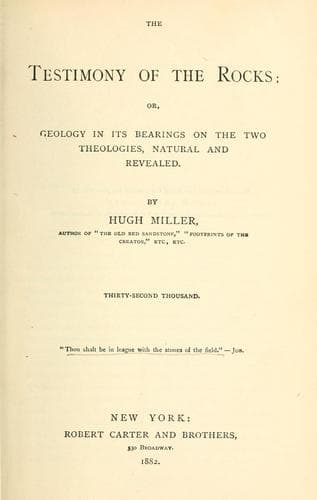
The Testimony of the Rocks: or, Geology in Its Bearings on the Two Theologies, Natural and RevealedMiller, Hugh
Philosophy
The Testimony of the Rocks: or, Geology in Its Bearings on the Two Theologies, Natural and Revealed
Miller, Hugh
Bible and geology; Creation; Religion and science
had at length arrived when the earth had become fixed and stable, and
the proud waves of ocean had been stayed,--when, after species and
genera in both kingdoms had been increased tenfold beyond the precedent
of any former age, the Creative Hand seemed to pause in its working, and
the finished creation to demand its lord! Even at this late period, how
strange may not the doubts and uncertainties have been that remained to
darken the mind of the lost spirit! It was according to his
experience,--stretched backwards to the first beginnings of organic
vitality, and coextensive, at a still earlier period, with God's
spiritual universe,--that all _animals_ should die,--that all _moral
agents_ should live. How, in this new creature,--this prodigy of
creation, who was to unite what never before had been united,--the
nature of the animals that _die_ with the standing and responsibility of
the moral agents that _live_,--how, in this partaker of the double
nature, was the discrepancy to be reconciled? How, in this matter, were
the opposite claims of life and death to be adjusted, or the absolute
_immortality_, which cannot admit of degrees, to be made to meet with
and shade into the _mortality_ which, let us extend the term of previous
vitality as we may, must forever involve the antagonistic idea of final
annihilation and the ceasing to be?
At length creation receives its deputed monarch. For, moulded by God's
own finger, and in God's own likeness, man enters upon the scene, an
exquisite creature, rich in native faculty, pregnant with the yet
undeveloped seeds of all wisdom and knowledge, tender of heart and pure
of spirit, formed to hold high communion with his Creator, and to
breathe abroad his soul in sympathy over all that the Creator had made.
And yet, left to the freedom of his own will, there is a weakness in the
flesh that betrays his earthly lineage. It is into the dust of the
ground that the living soul has been breathed. The son of the soil, who,
like the inferior animals, his subjects, sleeps and wakes, and can feel
thirst and hunger, and the weariness of toil, and the sweets of rest,
and who come under the general law, "increase and multiply," promulgated
of old to them, stands less firmly than the immaterial spirits stood of
old; and yet even they rebelled against Heaven, and fell. There awakes a
grim hope in the sullen lord of the first revolt. Ages beyond tale or
reckoning has this temple of creation been in building. Long have its
mute prophecies in fishes and in creeping things, in bird and in beast,
told of coming man, its final object and end. And now there needeth but
one blow, and the whole edifice is destroyed, God's purposes marred and
frustrated, and this new favorite of earth dashed back to the dust out
of which he was created, and brought, like the old, extinct races, under
the eternal law of death. Armed with the experience in evil of unsummed
ages, the Tempter plies his work: nor is it to low or ignoble appetites
Public-domain text, read in full here on John Shaqi.
Reviews
Reviews
No reviews yet
Be the first to share your thoughts on this work.
Elsewhere in the archive
Join the Discussion
Join the discussion
Sign in to leave a comment or review.
Sign InorCreate an account