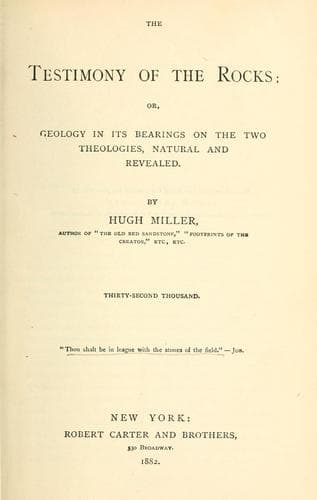
The Testimony of the Rocks: or, Geology in Its Bearings on the Two Theologies, Natural and RevealedMiller, Hugh
Philosophy
The Testimony of the Rocks: or, Geology in Its Bearings on the Two Theologies, Natural and Revealed
Miller, Hugh
Bible and geology; Creation; Religion and science
that he appeals. It is to the newly-formed creature's thirst for
knowledge; it is to his love stronger than death. The wiles of the Old
Serpent prevail; man falls prostrate before him; creation trembles; and
then from amid the trees of the garden comes the voice of God. And lo!
in an enigma mysterious and dark a new dispensation of prophecy begins.
Victims bleed; altars smoke; the tabernacle arises amid the white tents
of the desert; the temple ascends all glorious on the heights of Mount
Zion; prophet after prophet declares his message. At length, in the
fulness of time, the Messiah comes; and, in satisfying the law, and in
fulfilling all righteousness, and in bringing life and immortality to
light, abundantly shows forth that the terminal dynasty of all creation
had been of old foreordained, ere the foundations of the world, to
possess for its eternal lord and monarch, not primeval man, created in
the image of God, but God, made manifest in the flesh, in the form of
primeval man. But how breaks on the baffled Tempter the sublime
revelation? Wearily did he toil,--darkly did he devise, and take, in his
great misery, deep counsel against the Almighty; and yet all the while,
while striving and resisting as an enemy, has he been wielded as a tool;
when, glaring aloof in his proud rebellion, the grasp of the Omnipotent
has been upon him, and the Eternal Purposes have encompassed him, and he
has been working out, all unwittingly, the foreordained decree, "For our
God maketh the wrath of the wicked to praise him, and the remainder
thereof doth he restrain."
But enough, for the present, of the poems that might be. Permit me,
however, to add, in the words of one of the most suggestive, and
certainly not least powerful, of English thinkers, that "a fall of some
sort or other,--the creation, as it were, of the non-absolute,--is the
fundamental postulate of the moral history of man. Without this
hypothesis," he adds, "man is unintelligible,--with it every phenomenon
is explicable. The mystery itself is too profound for human insight."
Such, in this matter, was the ultimate judgment of a man who in youth
had entertained very opposite views,--the poet Coleridge.
It has been said that the inferences of the geologist militate against
those of the theologian. Nay, not those of our higher geologists and
higher theologians,--not what our Murchisons and Sedgwicks infer in the
one field, with what our Chalmerses and Isaac Taylors infer in the
other. Between the Word and the Works of God there can be no actual
discrepancies; and the seeming ones are discernible only by the men who
see worst.
"Mote-like they flicker in unsteady eyes,
And weakest his who best descries."
Public-domain text, read in full here on John Shaqi.
Reviews
Reviews
No reviews yet
Be the first to share your thoughts on this work.
Elsewhere in the archive
Join the Discussion
Join the discussion
Sign in to leave a comment or review.
Sign InorCreate an account