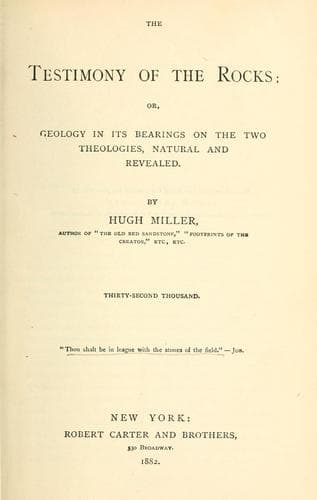
The Testimony of the Rocks: or, Geology in Its Bearings on the Two Theologies, Natural and RevealedMiller, Hugh
Philosophy
The Testimony of the Rocks: or, Geology in Its Bearings on the Two Theologies, Natural and Revealed
Miller, Hugh
Bible and geology; Creation; Religion and science
When, however, the doctor passes to argument based upon natural science,
we find what he adduces worthy of our attention, were it but for the
inquiries which it suggests. "If the deluge were but local," we find him
saying, "what was the need of taking _birds_ into the ark; and among
them birds so widely diffused as the raven and the dove? A deluge which
could overspread the region which these birds inhabit could hardly have
been less than universal. If the deluge were local, and all the birds of
these kinds in that district perished,--though we should think they
might have fled to the uninundated regions,--it would have been useless
to encumber the ark with them, seeing that the birds of the same species
which survived in the lands not overflowed would speedily replenish the
inundated tract as soon as the waters subsided." It will be found that
the reasoning here is mainly based upon an error in natural science,
into which even naturalists of the last century, such as Buffon, not
unfrequently fell, and which was almost universal among the earlier
voyagers and travellers,--the error of confounding as identical the
merely allied birds and beasts of distant countries, and of thus
assigning to _species_ wide areas in creation which in reality they do
not occupy. The grouse, for instance, is a widely spread genus, or
rather _family_; for it consists of more genera than one. It is so
extensively present over the northern hemisphere, that Siberia, Norway,
Iceland, and North America, have all their grouse,--the latter
continent, indeed, from five to eight different kinds; and yet so
restricted are some of the species of which they consist, that, were the
British islands to be submerged, one of the best known of the
family,--the red grouse, or moor-fowl (_Lagopus Scoticus_),--would
disappear from creation. This bird, which, rated at its money value, is
one of the most important in Europe,--for the barren moors which it
frequents in the Highlands of Scotland alone are let every season almost
entirely for its sake for hundreds of thousands of pounds,--is
exclusively a British bird; and, unless by miracle a new migratory
instinct were given to it, a complete submersion of the British islands
would secure its destruction. If the submergence amounted to but a few
hundred miles in lateral extent, the moor-fowl would to a certainty not
seek the distant uninundated land. Nor is it at all to be inferred, that
in a merely local but wide spread deluge, birds occupying a more
extensive area than that overspread by the Flood would, according to Dr.
Kitto, "speedily replenish the inundated tract as soon as the waters had
subsided." The statement must have been hazarded in ignorance of the
peculiar habits of many of the non-migratory birds. Up till about the
middle of the last century, the capercailzie, or great cock of the
woods, was a native of Scotland. It was exterminated, however, about the
time of the last Rebellion, or not long after: the last specimen seen
Public-domain text, read in full here on John Shaqi.
Reviews
Reviews
No reviews yet
Be the first to share your thoughts on this work.
Elsewhere in the archive
Join the Discussion
Join the discussion
Sign in to leave a comment or review.
Sign InorCreate an account