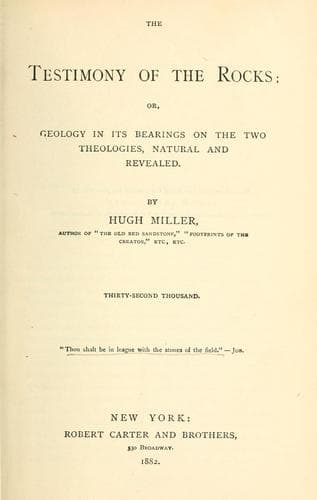
The Testimony of the Rocks: or, Geology in Its Bearings on the Two Theologies, Natural and RevealedMiller, Hugh
Philosophy
The Testimony of the Rocks: or, Geology in Its Bearings on the Two Theologies, Natural and Revealed
Miller, Hugh
Bible and geology; Creation; Religion and science
among the pine forests of Strathspey was killed, it is said, in the year
1745: the last specimen seen among the woods of Strathglass survived
till the year 1760. Pennant relates that he saw in 1769 a specimen,
probably a stuffed one, that had been killed shortly before in the
neighborhood of Inverness. But from at least that time the species
disappeared from the British islands; and, though it continued to exist
in Norway, did not "replenish the tracts from which it had been
extirpated." The late Marquis of Breadalbane was at no small cost and
trouble in re-introducing the species, and to some extent he succeeded;
but the capercailzie is, I understand, still restricted to the
Breadalbane woods. I have seen the golden eagle annihilated as a species
in move than one district of the north of Scotland; nor, though it still
exists in other parts of the kingdom, and is comparatively common among
the mountains of Norway, have I known it in any instance to spread anew
over the tracts from which it had been extirpated. So much for the
general reasonings of Dr. Kitto. Further, we find him stating, that a
deluge which could overspread the region inhabited by birds so widely
diffused as the raven and the dove, could hardly have been less than
universal. The doctor, however, ought to have known that the _dove_ is a
_family_, not a _species_. All the American species of doves, for
example, differ from the six European species, three of which are to be
found in Scotland. Of even the American passenger pigeons (_Ectopistes
migratoria_), which occur in such numbers in their native country as
actually to eclipse, during their migratory flights, the light of day,
only a single straggler,--the one whose chance visit has been recorded
by Dr. Fleming,--seems to have been ever seen in Britain. And the East
has also its own peculiar species, unknown to Europe. The golden-green
pigeons and the great crowned pigeons of the Indian isles are never seen
in northern and western latitudes, save in stuffed specimens in a
museum. The Vinago pigeons, with their vividly bright plumes, though
they exist in several species, are all restricted to the woods of the
torrid zone. Even the collared dove of Africa and the Levant rarely
visits, and then only as a straggler, the western and northern parts of
Europe. The blue-capped turteline pigeon is restricted, as a species, to
the island of Celebes; the blue and green turteline pigeon is a native
of New Guinea; the Cape turtle occurs in but the southern parts of
Africa; the Nicobar ground pigeon in but the Indian Archipelago; the
magnificent fruit pigeon in the eastern parts of Australia; and the
crowned goura pigeon, the giant of its family, in the Molucca Islands.
No single species of dove seems to be so widely spread but that it might
be exterminated in a merely partial deluge; and of course conjecture may
in vain weary itself in striving to determine what that particular
Public-domain text, read in full here on John Shaqi.
Reviews
Reviews
No reviews yet
Be the first to share your thoughts on this work.
Elsewhere in the archive
Join the Discussion
Join the discussion
Sign in to leave a comment or review.
Sign InorCreate an account