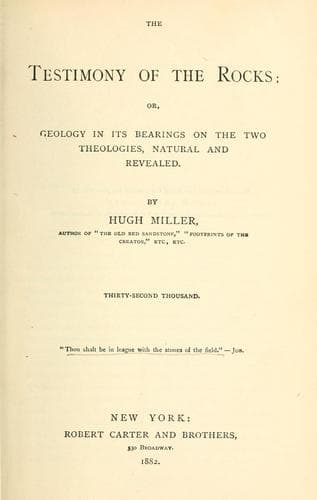
The Testimony of the Rocks: or, Geology in Its Bearings on the Two Theologies, Natural and RevealedMiller, Hugh
Philosophy
The Testimony of the Rocks: or, Geology in Its Bearings on the Two Theologies, Natural and Revealed
Miller, Hugh
Bible and geology; Creation; Religion and science
The form and dimensions of Noah's ark are definitely given in the sacred
record. It seems to have been a great oblong box, somewhat like a wooden
granary, three stories high, and furnished with a roof apparently of the
ordinary angular shape, but with a somewhat broader ridge than common;
and it measured three hundred cubits in length, fifty cubits in breadth,
and thirty cubits in height. A good deal of controversy has, however,
arisen regarding the cubit employed; some holding, with Sir Walter
Raleigh, and most of the older theologians, such as Shuckford and Hales,
that the Noachian cubit was what is known as the common or natural
cubit, "containing," says Sir Walter, "one foot and a half, or a length
equal to that of the human fore-arm measured from the sharp of the elbow
to the point of the middle finger;" others contending that it was the
palm-cubit, "which taketh," adds my authority, "one handful more than
the common;" yet others, the royal or Persian cubit of twenty-one
inches; and so on; for there are, it seems, five several kinds of cubit
to choose from, all differing each from the others. The controversy is
one in which there is exceeding little footing for any party. I am
inclined, however, to adopt, with Raleigh and Hales, the _natural_
cubit, for the following reason. The given dimensions of the ark form
the oldest example of measurement of which we have any record; and all,
or almost all, the older and simpler standards of measure bear reference
to portions of the human frame. There is the span, the palm, the
hand-breadth, the thumb-breadth (or inch), the hair-breadth, and the
_foot_. The simple fisherman on our coasts still measures off his
fathoms by stretching out both his arms to the full; the village
sempstress still tells off her cloth-breadths by finger-lengths and
_nails_; the untaught tiller of the soil still estimates the area of his
little field by _pacing_ along its sides. Man's first and most obvious
expedient, when he sets himself to measure, is to employ his own person
as his standard; and the first or common cubit was a measure of this
natural description equal in length to the extended fore-arm and hand.
All the other cubits were artificial compounds of after introduction;
and so, in the absence of direct evidence on the point, I accept the
most natural and oldest cubit as in all probability the one employed in
the oldest recorded piece of cubit measurement. And the ark, if measured
by the common or natural cubit, must have been a vessel four hundred and
fifty feet in length, seventy-five feet in breadth, and forty-five feet
in height. Dr. Kitto, however, though we find him remarking that in
computations of Scripture measures the cubit may be regarded as half a
yard (Sir Walter's estimate), adopts, in his own computation of the size
of the ark, without assigning any reason why, the palm-cubit, or cubit
of twenty-one inches and nearly nine lines (21.888 inches); and, waving
Public-domain text, read in full here on John Shaqi.
Reviews
Reviews
No reviews yet
Be the first to share your thoughts on this work.
Elsewhere in the archive
Join the Discussion
Join the discussion
Sign in to leave a comment or review.
Sign InorCreate an account