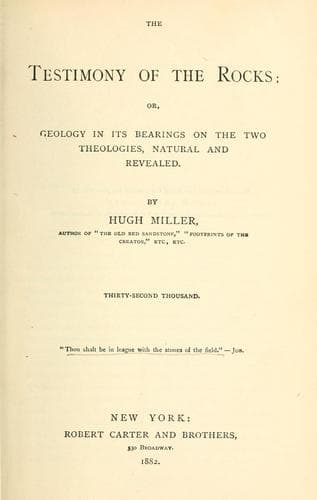
The Testimony of the Rocks: or, Geology in Its Bearings on the Two Theologies, Natural and RevealedMiller, Hugh
Philosophy
The Testimony of the Rocks: or, Geology in Its Bearings on the Two Theologies, Natural and Revealed
Miller, Hugh
Bible and geology; Creation; Religion and science
all controversy on the question, let us, for the argument's sake, admit
the larger measure. Let us,--however much inclined to hold with Raleigh,
Shuckford, and Hales,--agree with Dr. Kitto that the ark was five
hundred and forty-seven feet in length, by ninety-one feet in breadth.
Such dimensions, multiplied by three, the number of stories in the
vessel, would give an area equal to about one seventh that of the great
Crystal Palace of 1851. Or, to take a more definite illustration from
the same vast building, the area of the three floors of the ark, taken
together, would fall short by about twenty-eight thousand square feet of
that of the northern gallery of the Palace, which measured one thousand
eight hundred and forty-eight feet in length, by ninety-six feet in
breadth. And thus, yielding to our opponents their own large
measurements, let us now see whether the non-universality of the deluge
cannot be fairly predicated from the dimensions of the ark.
I may first remark, however, that measures so definite as those given by
Moses (definite, of course, if we waive the doubt regarding the cubit
employed) were effectual in setting the arithmeticians to work in all
ages of the Church, in order to determine whether all the animals in the
world, by sevens and by pairs, with food sufficient to serve them for a
twelvemonth, could have been accommodated in the given space. It was a
sort of stock problem, that required, it was thought, no very high
attainments to solve. Eighty years have not yet passed since kind old
Samuel Johnson, in writing to little Miss Thrale a nice little letter,
recommending her to be a good girl, and to mind her arithmetic, advised
her to try the ark problem. "If you can borrow 'Wilkins' Real
Character,'" we find him saying to the young lady, "a folio which
perhaps the booksellers can let you have, you will have a very curious
calculation, _which you are qualified to consider_, to show that Noah's
ark was capable of holding all the known animals of the world, with
provision for all the time in which the earth was under water."
Unluckily, however, though the dimensions of the ark were known, the
animals of the world were not; and so the question, in at least one of
its terms, had to be very frequently restated. Let us take it as we find
it presented (drawn, however, from a much older source), in Sir Walter
Raleigh's magnificent "History of the World." "If in a ship of such
greatness," says this distinguished man, "we seek room for eighty-nine
distinct species of beasts, or, lest any should be omitted, for a
hundred several kinds, we shall easily find place both for them and for
the birds, which in bigness are no way answerable to them, and for meat
to sustain them all. For there are three sorts of beasts whose bodies
are of a quantity well known; the beef, the sheep, and the wolf; to
which the rest may be reduced by saying, according to Aristotle, that
one elephant is equal to four beeves, one lion to two wolves, and so of
Public-domain text, read in full here on John Shaqi.
Reviews
Reviews
No reviews yet
Be the first to share your thoughts on this work.
Elsewhere in the archive
Join the Discussion
Join the discussion
Sign in to leave a comment or review.
Sign InorCreate an account