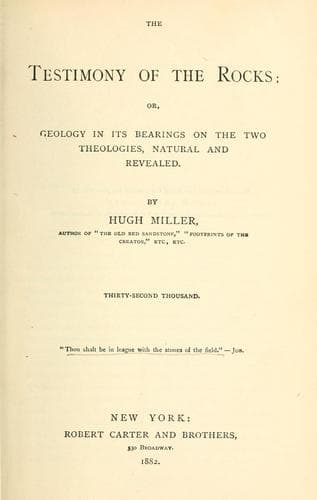
The Testimony of the Rocks: or, Geology in Its Bearings on the Two Theologies, Natural and RevealedMiller, Hugh
Philosophy
The Testimony of the Rocks: or, Geology in Its Bearings on the Two Theologies, Natural and Revealed
Miller, Hugh
Bible and geology; Creation; Religion and science
As man extended his acquaintance with the mammals, he found their number
greatly increasing on his hands. Button, like Raleigh, though a
professed naturalist, and a writer of admirable genius, had no very
distinct notions of species. He was inclined to question whether even
the ass might not be merely a degraded horse; and confounded many of the
mammals of the New World with their representative congeners in the Old.
And yet, in summing up his history of the mammaliferous division, he
could state, that though it included descriptions of "a hundred and
thirty-four different species of creatures that suckled their young,
many of which had not been observed or described before," it was
necessarily incomplete, as there were still others to add to the list,
for whose history there existed no materials. At the same time he
remarked, however, that the "number of quadruped animals whose existence
is certain and well established does not amount to more than two
hundred on the surface of the known world." Yet here was the extreme
estimate made by Raleigh, with what he deemed large allowance for the
unknown animals, fairly doubled; and under the hands of more
discriminating naturalists, and in the inevitable course of discovery,
the number has so enormously increased, that the "eighty-nine distinct
species" known to the great voyager have been represented during the
last thirty years by the one thousand mammals of Swainson's estimate,
the one thousand one hundred and forty-nine mammals of Charles
Bonaparte's estimate, the one thousand two hundred and thirty mammals of
Winding's estimate, and the one thousand five hundred mammals of Oken's
estimate. In the first edition of the admirable "Physical Atlas" of
Johnston (published in 1848) there are one thousand six hundred and
twenty-six different species of mammals enumerated; and in the second
edition (published in 1856), one thousand six hundred and fifty-eight
species. And to this very extraordinary advance on the eighty-nine
mammals of Raleigh, and the two hundred mammals of Buffon, we must add
the six thousand two hundred and sixty-six birds of Lesson, and the six
hundred and fifty-seven reptiles of Charles Bonaparte; or at
least,--subtracting the sea snakes, and perhaps the turtles, as fitted
to live outside the ark,--his six hundred and _forty-two_ reptiles.[29]
Public-domain text, read in full here on John Shaqi.
Reviews
Reviews
No reviews yet
Be the first to share your thoughts on this work.
Elsewhere in the archive
Join the Discussion
Join the discussion
Sign in to leave a comment or review.
Sign InorCreate an account