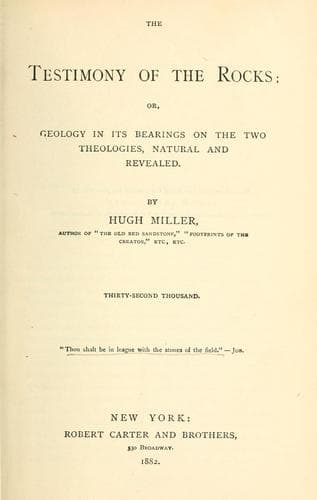
The Testimony of the Rocks: or, Geology in Its Bearings on the Two Theologies, Natural and RevealedMiller, Hugh
Philosophy
The Testimony of the Rocks: or, Geology in Its Bearings on the Two Theologies, Natural and Revealed
Miller, Hugh
Bible and geology; Creation; Religion and science
Such is the number of the known vertebrates, exclusive of the fishes,
with which in this question we have now to deal. Still, however, there
are a few lingering theologians, some of them very intelligent men, who
continue to regard the ark as quite big enough for them all. Dr.
Hamilton of Mobile, for instance, after fairly stating Swainson's
estimate, namely, one thousand mammalia, six thousand birds, and one
thousand five hundred reptiles and amphibiæ, goes on to say, that "it
must not be forgotten, that of all these, the vastly greater proportion
are small; and that numbers of them could be placed together in the same
compartment of the ark." This, however, permit me to say with all
respect, is not meeting the real difficulty. No doubt many of the birds
are small,--many of the reptiles are small,--many even of the mammals
are small,--many small animals were known in the days of Raleigh, and
a much greater number of small animals are known now; but the question
proper to the case seems to be, What proportions do both the large
and the small animals now known bear to the large and small animals
known in the days of Raleigh or Buffon; and how much additional
accommodation-room would they require during their supposed voyage of a
twelvemonth? There are two different ways in which the list of the
known animals has been increased, especially of the known mammals. They
have been increased in a certain appreciable proportion by _discovery_;
and as discovery has been made chiefly in islands,--for the great
continents had been previously known,--and as the mammals of islands, as
has been well remarked by Cuvier, are usually small, of this appreciable
proportion the bulk is comparatively not great. The great kangaroo
(_Macropus giganteus_), though the inhabitant of an island which ranks
among the continents, would not much exceed in bulk, tried by Raleigh's
quaint scale of measurement, a sheep and a half, or at most two sheep;
and yet I know not that discovery in the islands has added a larger
animal to the previously known ones than the great kangaroo. Mr.
Waterhouse, when he published, in 1841, his "History of the
Marsupialia," reckoned up one hundred and five distinct species of
pouched animals; and eighteen species more,--in all one hundred and
twenty-three,--have been since added to the order. With the exception of
an opossum or two, all these marsupiata may be regarded as discoveries
made since the time of Buffon; most of them, as I have said, are small.
And such, generally, has been the nature of the revelations made during
the last seventy years by positive _discovery_. It is not, however, by
discovery, but by scientific scrutiny into the true nature and
distinctions of species, that the recent enormous increase in the number
of the known mammals has mainly taken place. And in these cases it will
generally be found that the new species, which had been previously
confounded with some old ones, so nearly resemble the latter in bulk, as
Public-domain text, read in full here on John Shaqi.
Reviews
Reviews
No reviews yet
Be the first to share your thoughts on this work.
Elsewhere in the archive
Join the Discussion
Join the discussion
Sign in to leave a comment or review.
Sign InorCreate an account