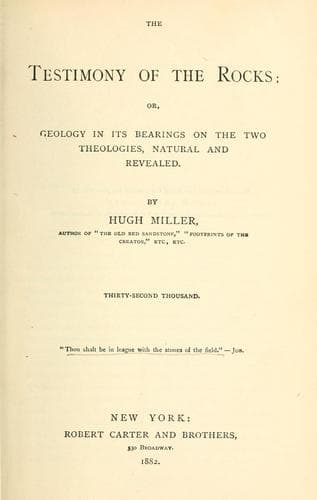
The Testimony of the Rocks: or, Geology in Its Bearings on the Two Theologies, Natural and RevealedMiller, Hugh
Philosophy
The Testimony of the Rocks: or, Geology in Its Bearings on the Two Theologies, Natural and Revealed
Miller, Hugh
Bible and geology; Creation; Religion and science
In so great a majority of cases has it increased its _bulk_ in the ratio
in which it has increased its numbers, that if one ark was not deemed
more than sufficient to accommodate the animal world known to the French
naturalist of eighty years ago, it would require at least from five to
six arks to accommodate the animal world known in the present day.
Even in the days of Buffon, however, and at a still earlier period, the
ark, regarded as a natural means of preservation from death by
_drowning_, was usually coupled, in the case of at least the carnivorous
animals, with certain miraculous provisions against death by _starving_.
It seems to have been generally taken for granted, that the flesh-eating
animals, when introduced to the shelter of the ark, entirely changed the
nature indicated by their form of teeth, the character of their
stomachs, and the shortness of their bowels, and fed, for the time they
remained in it, exclusively on vegetable substances, which, in ordinary
circumstances, their lacteals could not have converted into chyle.
Certain figurative expressions in Scripture taken literally, which refer
to a class of wild animals whose real destiny is rather, it would seem,
to be extirpated than to be changed, coupled with the belief, now no
longer tenable, that there was a time, ere man had sinned, when there
was no death among the inferior creatures, and of course no eaters of
flesh, rendered the belief easy of reception; but it involved a miracle
nowhere recorded; and the burden of the proof that such a miracle
actually took place in the circumstances lies of necessity on the
assertors of a universal deluge. Further, of even the creatures that
live on vegetables, many are restricted in their food to single plants,
which are themselves restricted to limited localities and remote regions
of the globe. Dr. Hamilton has not referred, in his list of animals, to
the insects,--a class which, though they were estimated in 1842 to
consist of no fewer than five hundred and fifty thousand species, might
yet be accommodated in a comparatively limited space. But how
extraordinary an amount of miracle would it not require to bring them
all together into any one centre, or to preserve them there! Many of
them, like the myriapoda and the thysanura, have no wings, and but
feeble locomotive powers; many of them, such as the ephemera and the
male ants, live after they have got their wings only a few hours, or at
most a few days; and there are myriads of them that can live upon but
single plants that grow in very limited botanic centres. Even supposing
them all brought into the ark by miracle as eggs, what multitudes of
them would not, without the exertion of further miracle, require to be
sent back to their proper habitats as wingless grubs, or as insects
restricted by nature to a few days of life! Or, supposing the eggs all
left in their several localities to lie under water for a twelvemonth
Public-domain text, read in full here on John Shaqi.
Reviews
Reviews
No reviews yet
Be the first to share your thoughts on this work.
Elsewhere in the archive
Join the Discussion
Join the discussion
Sign in to leave a comment or review.
Sign InorCreate an account