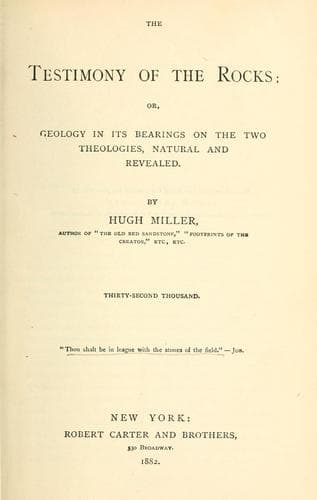
The Testimony of the Rocks: or, Geology in Its Bearings on the Two Theologies, Natural and RevealedMiller, Hugh
Philosophy
The Testimony of the Rocks: or, Geology in Its Bearings on the Two Theologies, Natural and Revealed
Miller, Hugh
Bible and geology; Creation; Religion and science
amid mud and debris,--though certain of the hardier kinds might survive
such treatment, by miracle alone could the preponderating majority of
the class be preserved. And be it remembered, that the expedient of
having recourse to supposititious miracle in order to get over a
difficulty insurmountable on every natural principle, is not of the
nature of argument, but simply an evidence of the want of it. Argument
is at an end when supposititious miracle is introduced.
But the very inadequate size of the ark, though a conclusive proof that
all, or nearly all, the progenitors of our existing animals could not
have harbored within it from any general cataclysm, does not furnish a
stronger argument against the possibility of any such assemblage, than
the peculiar manner in which we now find these animals distributed over
the earth's surface. Linnæus held, early in the last century, that all
creatures which now inhabit the globe had proceeded originally from some
such common centre as the ark might have furnished; but no zoologist
acquainted with the distribution of species can acquiesce in any such
conclusion now. We now know that every great continent has its own
peculiar fauna; that the original centres of distribution must have
been, not one, but many; further, that the areas or circles around these
centres must have been occupied by their pristine animals in ages long
anterior to that of the Noachian Deluge; nay, that in even the latter
geologic ages, they were preceded in them by animals of the same general
type. There are fourteen such areas or provinces enumerated by the later
naturalists. It may be well, however, instead of running any risk of
losing ourselves amid the less nicely defined provinces of the Old
World, to draw our illustrations from two and a half provinces of later
discovery, whose limits have been rigidly fixed by nature. "The great
continents," says Cuvier, "contain species peculiar to each; insomuch
that whenever large countries of this description have been discovered,
which their situation had kept isolated from the rest of the world, the
class of quadrupeds which they contained has been found extremely
different from any that had existed elsewhere. Thus, when the Spaniards
first penetrated into South America, they did not find a single species
of quadruped the same as any of Europe, Asia, or Africa. The puma, the
jaguar, the tapir, the cabiai, the lama, the vicuna, the sloths, the
armadilloes, the opossums, and the whole tribe of sapajous, were to them
entirely new animals, of which they had no idea. Similar circumstances
have recurred in our own time, when the coasts of New Holland and the
adjacent islands were first explored. The various species of kangaroo,
phascolomys, dasyurus, and perameles, the flying phalangers, the
ornithorynchi, and echidnæ, have astonished naturalists by the
strangeness of their conformations, which presented proportions contrary
Public-domain text, read in full here on John Shaqi.
Reviews
Reviews
No reviews yet
Be the first to share your thoughts on this work.
Elsewhere in the archive
Join the Discussion
Join the discussion
Sign in to leave a comment or review.
Sign InorCreate an account