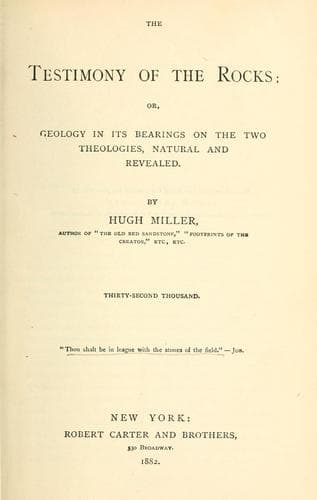
The Testimony of the Rocks: or, Geology in Its Bearings on the Two Theologies, Natural and RevealedMiller, Hugh
Philosophy
The Testimony of the Rocks: or, Geology in Its Bearings on the Two Theologies, Natural and Revealed
Miller, Hugh
Bible and geology; Creation; Religion and science
There is, however, a class of learned and thoroughly respectable
theologians who seem disposed to accept rather of any amount of
unrecorded miracle, than to admit of a merely partial deluge,
coextensive with but the human family. "Were the difficulty attending
this subject tenfold greater, and seemingly beyond all satisfactory
explanation," says Dr. William Hamilton, "if I yet find it recorded in
the Book of Revelation, that in the deluge '_every living thing in which
is the breath of life perished, and Noah only remained alive, and they
which were with him in the ark_,' I could still believe it implicitly,
satisfied that the difficulty of explanation springs solely from the
imperfection of human knowledge, and not from any limitation in the
power or the wisdom of God, nor yet from any lack of trustworthiness in
the document given us in a revelation from God,--a document given to men
by the hands of Moses, the learned, accomplished, and eminently devout
Jewish legislator." Here again, however, Dr. Hamilton seems to have
mistaken the question actually at issue. The true question is, not
whether or no Moses is to be believed in the matter, but whether or no
we in reality understand Moses. The question is, whether we are to
regard the passages in which he describes the Flood as universal, as
belonging to the very numerous metonymic texts of Scripture in which a
part--sometimes a not very large part--is described as the whole, or to
regard them as strictly and severely literal. Or, in other words,
whether we are, with learned and solid divines of the olden time, such
as Poole and Stillingfleet, and with many ingenious and accomplished
divines of the passing age, such as the late Dr. Pye Smith and the Rev.
Professor Hitchcock, to regard these passages as merely metonymic; or,
with Drs. Hamilton and Kitto, to regard them as strictly literal, and to
call up in support of the literal reading an amount of supposititious
miracle, compared with which all the recorded miracles of the Old and
New Testaments sink into insignificance. The controversy does not lie
between Moses and the naturalists, but between the _readings_ of
theologians such as Matthew Poole and Stillingfleet on the one hand, and
the _readings_ of theologians such as Drs. Hamilton and Kitto on the
other. And finding all natural science arrayed against the conclusions
of the one class, and in favor of those of the other, and believing,
further, that there has been always such a marked economy shown in the
exercise of miraculous powers, that there has never been more of miracle
employed in any one of the dispensations than was needed,[31] I must
hold that the theologians who believe that the deluge was but
coextensive with the moral purpose which it served are more in the
right, and may be more safely followed, than the theologians who hold
that it extended greatly further than was necessary. It is not with
Moses or the truth of revelation that our controversy lies, but with the
Public-domain text, read in full here on John Shaqi.
Reviews
Reviews
No reviews yet
Be the first to share your thoughts on this work.
Elsewhere in the archive
Join the Discussion
Join the discussion
Sign in to leave a comment or review.
Sign InorCreate an account