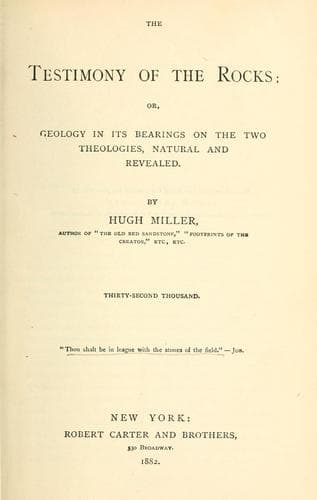
The Testimony of the Rocks: or, Geology in Its Bearings on the Two Theologies, Natural and RevealedMiller, Hugh
Philosophy
The Testimony of the Rocks: or, Geology in Its Bearings on the Two Theologies, Natural and Revealed
Miller, Hugh
Bible and geology; Creation; Religion and science
opponents of Stillingfleet and of Poole.
To only one of the other arguments employed in this controversy need I
at all refer. The cones of volcanic craters are formed of loose
incoherent scoriæ and ashes, and, when exposed, as in the case of
submarine volcanoes, such as Graham's Island and the islands of Nyoe and
Sabrina, to the denuding force of waves and currents, they have in a few
weeks, or at most a few months, been washed completely away. And yet in
various parts of the world, such as Auvergne in central France, and
along the flanks of Ætna, there are cones of long extinct or long
slumbering volcanoes, which, though of at least triple the antiquity of
the Noachian deluge, and though composed of the ordinary incoherent
materials, exhibit no marks of denudation. According to the calculations
of Sir Charles Lyell, no devastating flood could have passed over the
forest zone of Ætna during the last twelve thousand years,--for such is
the antiquity which he assigns to its older lateral cones, that retain
in integrity their original shape; and the volcanic cones of Auvergne,
which inclose in their ashes the remains of extinct animals, and present
an outline as perfect as those of Ætna, are deemed older still. Graham
Island arose out of the sea early in July, 1831; in the beginning of the
following August it had attained to a circumference of three miles, and
to a height of two hundred feet; and yet in less than three months from
that time the waves had washed its immense mass down to the sea level;
and in a few weeks more it existed but as a dangerous shoal. And such
inevitably would have been the fate of the equally incoherent cone-like
craters of Ætna and Auvergne during the seven and a half months that
intervened between the breaking up of the fountains of the great deep
and the reappearance of the mountain-tops, had they been included within
the area of the deluge. It is estimated that even the newer Auvergne
lavas are as old as the times of the Miocene. It is at least a
demonstrable fact, that the slow action of streams had hollowed them in
several places into deep chasms nearly two thousand years ago; for the
remains of Roman works of about that age survive, to show that they had
then, as now, to be spanned over by bridges, and that baths had been
erected in their denuded recesses; and yet the craters out of which
these lavas had flowed retain well nigh all their original sharpness of
outline. No wave ever dashed against their symmetrically sloping sides.
Now, I have in no instance seen the argument derivable from this class
of facts fairly met. The supposed mistake of the Canonico Recupero, or
rather of Brydone, who argued that the "lowest of a series of seven
distinct lavas of Ætna, most of them covered by thick intervening beds
of rich earth, must have been fourteen thousand years old," has been
often referred to in the controversy. Brydone or the Canon mistook, it
has been said, beds of brown ashes, each of which might have been
Public-domain text, read in full here on John Shaqi.
Reviews
Reviews
No reviews yet
Be the first to share your thoughts on this work.
Elsewhere in the archive
Join the Discussion
Join the discussion
Sign in to leave a comment or review.
Sign InorCreate an account