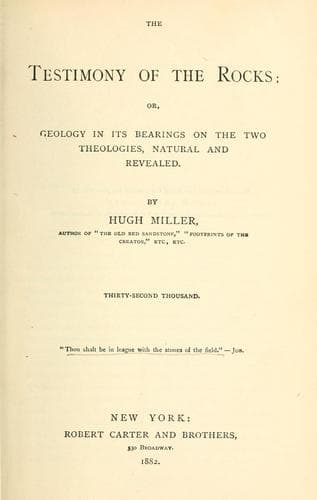
The Testimony of the Rocks: or, Geology in Its Bearings on the Two Theologies, Natural and RevealedMiller, Hugh
Philosophy
The Testimony of the Rocks: or, Geology in Its Bearings on the Two Theologies, Natural and Revealed
Miller, Hugh
Bible and geology; Creation; Religion and science
There is a remarkable portion of the globe, chiefly in the Asiatic
continent, though it extends into Europe, and which is nearly equal to
all Europe in area, whose rivers (some of them, such as the Volga, the
Oural, the Sihon, the Kour, and the Amoo, of great size) do not fall
into the ocean, or into any of the many seas which communicate with it.
They are, on the contrary, all _turned inwards_, if I may so express
myself; losing themselves, in the eastern parts of the tract, in the
lakes of a rainless district, in which they supply but the waste of
evaporation, and falling, in the western parts, into seas such as the
Caspian and the Aral. In this region there are extensive districts still
under the level of the ocean. The shore line of the Caspian, for
instance, is rather more than eighty-three feet beneath that of the
Black Sea; and some of the great flat steppes which spread out around
it, such as what is known as the Steppe of Astracan, have a mean level
of about thirty feet beneath that of the Baltic. Were there a
trench-like strip of country that communicated between the Caspian and
the Gulf of Finland to be depressed beneath the level of the latter sea,
it would _so open up the fountains of the great deep_ as to lay under
water an extensive and populous region, containing the cities of
Astracan and Astrabad, and many other towns and villages. Nor is it
unworthy of remark, surely, that one of the depressed steppes of this
peculiar region is known as the "Low Steppe of the Caucasus," and forms
no inconsiderable portion of the great recognized centre of the human
family. The Mount Ararat on which, according to many of our
commentators, the ark rested, rises immediately on the western edge of
this great hollow; the Mount Ararat selected as the scene of that event
by Sir Walter Raleigh, certainly not without some show of reason, lies
far within it. Vast plains, white with salt, and charged with sea
shells, show that the Caspian Sea was at no distant period greatly more
extensive than it is now. In an outer region, which includes the vast
desert of Khiva, shells also abound; but they seem to belong, as a
group, rather to some of the later Tertiary eras than to the recent
period. It is quite possible, however, that,--as on parts of the western
shores of our own country, where recent marine deposits lie over marine
deposits of the Pleistocene age, while a terrestrial deposit,
representative of an intervening paroxysm of upheaval, lies between,--it
is possible, I say, that in this great depressed area, the region
covered of old by a Tertiary sea, which we know united the Sea of Aral
with the Caspian, and rolled over many a wide steppe and vast plain, may
have been again covered for a brief period (after ages of upheaval) by
the breaking in of the great deep during that season of judgment when,
with the exception of one family, the whole human race was destroyed. It
seems confirmatory of this view, that during even the historic period,
Public-domain text, read in full here on John Shaqi.
Reviews
Reviews
No reviews yet
Be the first to share your thoughts on this work.
Elsewhere in the archive
Join the Discussion
Join the discussion
Sign in to leave a comment or review.
Sign InorCreate an account