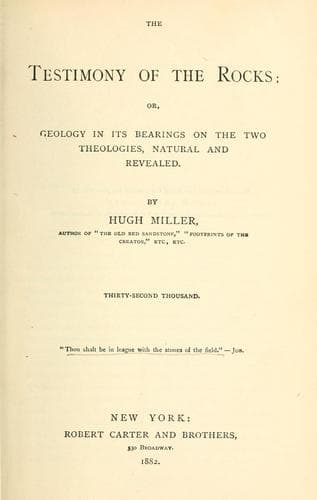
The Testimony of the Rocks: or, Geology in Its Bearings on the Two Theologies, Natural and RevealedMiller, Hugh
Philosophy
The Testimony of the Rocks: or, Geology in Its Bearings on the Two Theologies, Natural and Revealed
Miller, Hugh
Bible and geology; Creation; Religion and science
at least one of the neighboring inland seas, though it belongs to a
different system from that of the Caspian and the Aral, covered a vastly
greater area than it does now,--a consequence, apparently, of a more
considerable depression in the Caucasian region than at present exists.
Herodotus, as quoted by Cuvier in his "Theory of the Earth," represents
the Sea of Azoff as equal in extent to the Euxine.
With the known facts, then, regarding this depressed Asiatic region
before us, let us see whether we cannot originate a theory of the
Deluge free from at least the palpable monstrosities of the older ones.
Let us suppose that the human family, still amounting to several
millions, though greatly reduced by exterminating wars and exhausting
vices, were congregated in that tract of country which, extending
eastwards from the modern Ararat to far beyond the Sea of Aral, includes
the original Caucasian centre of the race: let us suppose that, the hour
of judgment having at length arrived, the land began gradually to sink,
as the tract in the run of Cutch sank in the year 1819, or as the tract
in the southern part of North America, known as the "sunk country," sank
in the year 1821: further, let us suppose that the depression took place
slowly and equably for forty days together, at the rate of about four
hundred feet per day,--a rate not twice greater than that at which the
tide rises in the Straits of Magellan, and which would have rendered
itself apparent as but a persistent inward flowing of the sea: let us
yet further suppose, that from mayhap some volcanic outburst coincident
with the depression, and an effect of the same deep seated cause, the
atmosphere was so affected, that heavy drenching rains continued to
descend during the whole time, and that, though they could contribute
but little to the actual volume of the flood,--at most only some five or
six inches per day,--they at least _seemed_ to constitute one of its
main causes, and added greatly to its terrors, by swelling the rivers,
and rushing downwards in torrents from the hills. The depression, which,
by extending to the Euxine Sea and the Persian Gulf on the one hand, and
to the Gulf of Finland on the other, would open up by three separate
channels the fountains of the great deep, and which included, let us
suppose, an area of about two thousand miles each way, would, at the end
of the fortieth day, be sunk in its centre to the depth of sixteen
thousand feet,--a depth sufficiently profound to bury the loftiest
mountains of the district; and yet, having a gradient of declination of
but sixteen feet per mile, the contour of its hills and plains would
remain apparently what they had been before,--the doomed inhabitants
would see but the water rising along the mountain sides, and one refuge
after another swept away, till the last witness of the scene would have
perished, and the last hill-top would have disappeared. And when, after
Public-domain text, read in full here on John Shaqi.
Reviews
Reviews
No reviews yet
Be the first to share your thoughts on this work.
Elsewhere in the archive
Join the Discussion
Join the discussion
Sign in to leave a comment or review.
Sign InorCreate an account