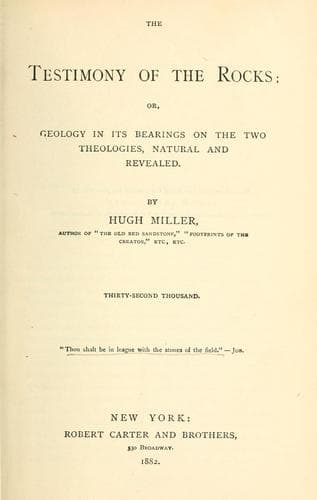
The Testimony of the Rocks: or, Geology in Its Bearings on the Two Theologies, Natural and RevealedMiller, Hugh
Philosophy
The Testimony of the Rocks: or, Geology in Its Bearings on the Two Theologies, Natural and Revealed
Miller, Hugh
Bible and geology; Creation; Religion and science
a hundred and fifty days had come and gone, the depressed hollow would
have begun slowly to rise,--and when, after the fifth month had passed,
the ark would have grounded on the summit of Mount Ararat,--all that
could have been seen from the upper window of the vessel would be simply
a boundless sea, roughened by tides, now flowing outwards, with a
reversed course, towards the distant ocean, by the three great outlets
which, during the period of depression, had given access to the waters.
Noah would of course see that "the fountains of the deep were stopped,"
and "the waters returning from off the earth continually;" but whether
the Deluge had been partial or universal, he could neither see nor know.
His prospect in either case would have been equally that described by
the poet Bowles:--
"The mighty ark
Rests upon Ararat; but nought around
Its inmates can behold, save o'er the expanse
Of boundless waters the sun's orient orb
Stretching the hull's long shadow, or the moon
In silence through the silver-curtained clouds
Sailing, as she herself were lost and left
In hollow loneliness."
Let me further remark, that in one important sense a partial Flood, such
as the one of which I have conceived as adequate to the destruction, in
an early age, of the whole human family, could scarce be regarded as
miraculous. Several of our first geologists hold, that some of the
formidable cataclysms of the remote past may have been occasioned by the
sudden upheaval of vast continents, which, by displacing great bodies of
water, and rolling them outwards in the character of enormous waves,
inundated wide regions elevated hundreds of feet over the sea level, and
strewed them over with the rock boulders, clays, gravels, and organic
debris of deep sea bottoms. And these cataclysms they regard as
perfectly natural, though of course very unusual, events. Nor would the
gradual depression of a continent, or, as in the supposed case, of a
portion of a continent, be in any degree less natural than the sudden
upheaval of a continent. It would, on the contrary, be much more
according to experience. Nay, were such a depression and elevation of
the great Asiatic basin to take place during the coming twelvemonth as
that of which I have conceived as the probable cause of the Deluge,
though the geologists would have to describe it as beyond comparison the
most remarkable oscillation of level which had taken place within the
historic period, they would certainly regard it as no more miraculous
than the great earthquake of Lisbon, or than that exhibition of the
volcanic forces which elevated the mountain of Jorullo in a single night
sixteen hundred feet over the plain. And why have recourse, in
speculating on the real event of four thousand years ago, to
supposititious miracle, if an event of apparently the same kind would
not be regarded as miraculous now? May we not in this matter take our
stand beside the poet, who, when recognizing a Providence in the great
Public-domain text, read in full here on John Shaqi.
Reviews
Reviews
No reviews yet
Be the first to share your thoughts on this work.
Elsewhere in the archive
Join the Discussion
Join the discussion
Sign in to leave a comment or review.
Sign InorCreate an account