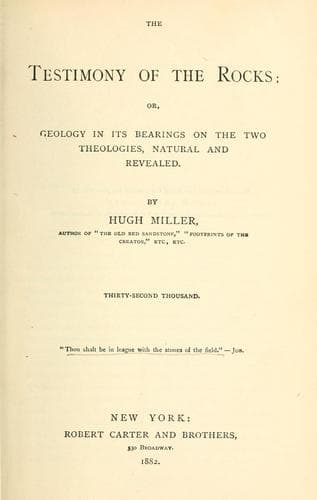
The Testimony of the Rocks: or, Geology in Its Bearings on the Two Theologies, Natural and RevealedMiller, Hugh
Philosophy
The Testimony of the Rocks: or, Geology in Its Bearings on the Two Theologies, Natural and Revealed
Miller, Hugh
Bible and geology; Creation; Religion and science
The Flood, however, is not left to do the whole geologic work, by even
such of the anti-geologists as assign to it the largest share. A great
unrecorded convulsion which accompanied the Fall is held by some of
their number to have greatly assisted, by laying down the older
formations of the fossiliferous rocks; and very much is said to have
been done during the extended antediluvian period that succeeded it. One
of perhaps the most amusing though least known of the writers that take
this special view is a Scotchman, resident in a secluded provincial
town, who for the last twelve or fifteen years has been printing
ingenious little books against the infidel geologists, and getting
letters of similar character inserted in such of our country newspapers
as are ambitious of rendering their science equal to their literature.
And from the great trouble which he has taken with the writings of the
individual who now addresses you, he seems to regard them as peculiarly
unsolid and dangerous. According to this profound cosmogonist, the world
before the Fall was rather more than twice its present size, and very
artificially constructed.[39] It was a hollow ball, supported inside by
a framework of metal wrought into hexagonal reticulations, somewhat like
the framework of the great iron bridge over the river Wear at
Sunderland; and which had an open space in its centre, occupied by a
vast tubular furnace lying direct south and north, which threw out huge
volumes of flame towards the poles. Over the reticulated framework there
rose a great, thick _firmament_ of metal, which formed the inner shell
of the globe; over the metal there lay a considerably thicker shell of
granite; and over the granite, a thinner shell of a substance not
specified, perhaps not known, but which, from its being completely
water-tight, served the purpose of the layer of asphalt or _terra cotta_
which the architect spreads over his flat roofs, or on the tops of his
sloping terraces, afterwards to be covered with soil and laid out into
gardens. Such, it seems, was that portion of the framework of our great
globe which corresponded to the hollow lath and plaster framework of the
little globes used in schools; while its uppermost layer,--correspondent
with the slips of the map which the geographer pastes on the model and
then varnishes,--was formed of earth and water, economically laid out
into "most useful and tasteful configurations,"--the earth into pretty
little rising grounds and valleys, and the water into seas and lakes of
no great extent, but which formed, from their very handsome
combinations, "a terraqueous surface all over PERFECTLY PARADISAICAL."
Over this exquisitely neat earth there lay an enveloping atmosphere,
greatly thinner and less dense than the air at present is, and
incapable, in consequence, of being agitated by storms; while directly
over the northern and southern extremities of the world the polar
Public-domain text, read in full here on John Shaqi.
Reviews
Reviews
No reviews yet
Be the first to share your thoughts on this work.
Elsewhere in the archive
Join the Discussion
Join the discussion
Sign in to leave a comment or review.
Sign InorCreate an account