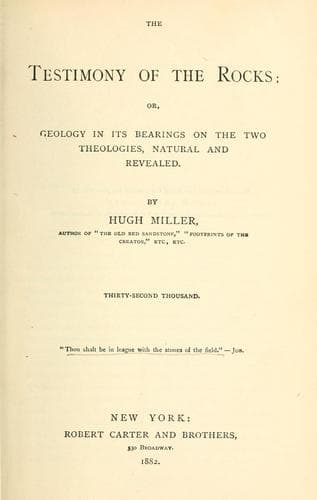
The Testimony of the Rocks: or, Geology in Its Bearings on the Two Theologies, Natural and RevealedMiller, Hugh
Philosophy
The Testimony of the Rocks: or, Geology in Its Bearings on the Two Theologies, Natural and Revealed
Miller, Hugh
Bible and geology; Creation; Religion and science
auroras, now so fitful and broken, extended in a permanent arch, and
gave light, during the long dark winters, to the regions lying below.
And as warmth was as necessary to the paradisaical perfection of these
districts as light, they received the necessary heat from the great
double-acting furnace in the interior, which, belching out flames at
both ends, acted powerfully against the polar portions of the metallic
crust or shell, and thus maintained the necessary glow in the absence of
the sun, on the principle on which a frying-pan or Scotch _girdle_ is
heated when placed by the cookmaid over the fire. And such, according to
this excellent world-fashioner and very zealous man, was the
construction of that unblighted and unbroken earth which was of old
pronounced to be "very good." The Fall, however, produced a most
remarkable and singularly disastrous change. The earth was somehow
partially crushed and broken, contemporaneously with the event,--like a
strong fishing basket when it accidentally falls from a coach-top under
the wheel; and, from a most interesting colored copperplate that
illustrates one of the author's treatises (for he draws as well as he
writes), the exact damage which it received can be minutely estimated.
The interior network was compressed into all sorts of irregular
polygons; the iron firmament was broken into great fragments,--some of
which may be seen in the print hanging down into the hollow interior,
like patches of broken plaster dangling from a ceiling, suspended by the
hairs originally employed to give the necessary tenacity to the lime.
The great granitic shell was also broken, but broken so nicely, on the
principle of the arch, that the pieces remained in nearly their original
places. Finally, vast rents are seen to occur in the cement and soil of
the outer crust; and these great rents, which must have formed enormous
gulfs and deep interminable ravines, were destined, it would seem, to
perform a most important part in the future geology of the globe.
Forming impassable lines of demarcation between the several portions
into which they broke up the earth's surface, they imprisoned the
recently created animals in separate groups, kept as completely from
mixing together as the fallow-deer of one loftily-walled park are kept
from mixing with the white oxen of another loftily-walled park, or as
the kangaroos or duck-billed quadrupeds of Australia are kept by the
surrounding ocean from mixing with the tigers of Sumatra or the
tortoises of Madagascar. I employ the writer's own happy
illustration:--"In some places these fragments" of the earth's crust
"would be piled more or less above each other, and in others quite
detached and isolated, like fragments of ice on the bank of a river
after a thaw." They would of course be on very different levels, each
having, as I have said, a distinct group of animals of its own; and
when, after the lapse of nearly two thousand years, the great
Public-domain text, read in full here on John Shaqi.
Reviews
Reviews
No reviews yet
Be the first to share your thoughts on this work.
Elsewhere in the archive
Join the Discussion
Join the discussion
Sign in to leave a comment or review.
Sign InorCreate an account