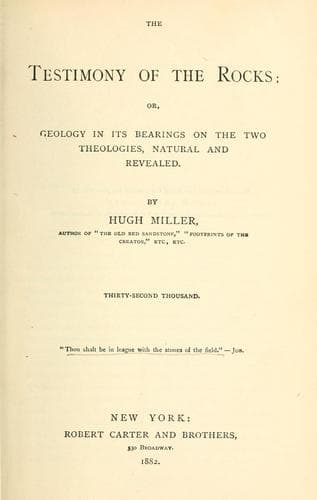
The Testimony of the Rocks: or, Geology in Its Bearings on the Two Theologies, Natural and RevealedMiller, Hugh
Philosophy
The Testimony of the Rocks: or, Geology in Its Bearings on the Two Theologies, Natural and Revealed
Miller, Hugh
Bible and geology; Creation; Religion and science
In this case, as in the other, let us grant, for the argument's sake,
all the facts. Let us admit that the trench through which the St.
Lawrence now flows has been cut by the river in somewhat less than six
thousand years. But through what, let us ask, has it been cut? There can
exist no doubt on the subject: it has been cut through an ancient
graveyard of the Upper Silurian system, charged with the peculiar
fossils characteristic of what are known as the Clinton and Niagara
groups, and common, many of them, to the Upper Silurian of our own
country and of the European continent. _Leptæna depressa_ and
_Pentamerus oblongus_, two of the most frequent shells of the deposit,
occur also in equal abundance in the Dudley and Caradoc formations of
England; its prevailing encrinite, _Ichthyocrinus lævis_, is scarce
distinguishable from an encrinite which I have often picked up in the
quarries of the "Wren's Nest" (_Ichthyocrinus pyriformis_); while its
prevailing trilobite, _Phacops limulurus_, seems to be but a
transatlantic variety of our well known _Asaphus (Phacops) caudatus_.
Further, the sequence of the various formations both above and below the
Niagara group, is shown with remarkable distinctness in that part of the
world along the shores of the great lakes. They may be traced downward,
on the one hand, along the Lower Silurian deposits, to the
non-fossiliferous base on which the system rests, and upwards, on the
other, through the Old Red Sandstone and the Carboniferous Limestone, to
the workable Coal Measures. Both stratigraphically and palæontologically
the place in the scale of the Niagara graveyard can be definitely
determined; and a superficial deposit on the heights in its immediate
neighborhood shows that the river did not begin its work of excavation
among its long extinct shells, trilobites, and corals, until after not
only the great Palæozoic, but also the Secondary and Tertiary divisions
had been laid down, and the recent period ushered in. The superficial
shells of the adjacent heights belong to the Pleistocene age, and show
that in even that comparatively modern time the lower lands of Upper
Canada were submerged beneath the level of the ocean, and that a series
of deep seas, connected by broad sounds, occupied the place of the great
lakes. Not until the last upheaval of the land was the river now known
as the St. Lawrence called into existence, to begin its work of
excavation; and ere that event took place, fully ten miles of
fossiliferous rock had been deposited on the earth's surface, charged
with the remains of many succeeding creations. The deposit through which
the St. Lawrence is slowly mining its way is older than the river itself
by the vast breadth of the four Tertiary periods, by that of all the
Secondary ages,--Cretaceous, Oolitic, and Triassic,--by the periods,
too, of the Permian system, of the Carboniferous system, of the Old Red
system, and of the uppermost beds of the Upper Silurian system. But a
Public-domain text, read in full here on John Shaqi.
Reviews
Reviews
No reviews yet
Be the first to share your thoughts on this work.
Elsewhere in the archive
Join the Discussion
Join the discussion
Sign in to leave a comment or review.
Sign InorCreate an account