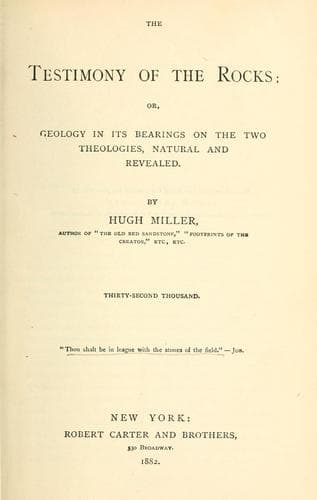
The Testimony of the Rocks: or, Geology in Its Bearings on the Two Theologies, Natural and RevealedMiller, Hugh
Philosophy
The Testimony of the Rocks: or, Geology in Its Bearings on the Two Theologies, Natural and Revealed
Miller, Hugh
Bible and geology; Creation; Religion and science
simple illustration may better serve to show the true character of the
conclusion urged here by the opponent of Sir Charles, than any such line
of statement as that which I employ, however clear to the geologist. In
the year 1817, Prince's Street, in Edinburgh, was opened up to the
Calton Hill, and the Calton burying-ground cut through to the depth of
many feet by the roadway. Let us suppose that when the excavation has
been carried a hundred yards into the cemetery, a geologist, finding the
laborers cutting on the average about a yard per day, simply intimates
as his opinion that the laborers have been a hundred days at work. "No,"
replies a controversialist on the anti-geological side; "for the first
fifty yards, so soft was the subsoil, and so shallow the covering of
mould, that the laborers must have cut at the rate of two yards a day;
it has been merely for the last fifty yards that they have been
excavating at the present slow rate: they cannot have been more than
seventy-five days at work. I marvel exceedingly at the absurdity of
geological reasoners: _palpably the burying-ground of the Calton is only
seventy-five days old._" Now, such, in no exaggerated, but, on the
contrary, greatly modified form, is the argument that would limit the
age of the earth to the period during which the St. Lawrence has been
scooping out a channel for itself, from Queenston to Niagara, through an
ancient Silurian burying-ground. Both arguments alike confound the age
of the ancient burying-grounds with the date of the modern excavations
opened up through them; but in order to render the argument of my
illustration equally absurd with the other, it would be not only
necessary to infer that the Calton cemetery was only seventy-five days
old, but also that the rock on which it rested was no older.
Public-domain text, read in full here on John Shaqi.
Reviews
Reviews
No reviews yet
Be the first to share your thoughts on this work.
Elsewhere in the archive
Join the Discussion
Join the discussion
Sign in to leave a comment or review.
Sign InorCreate an account