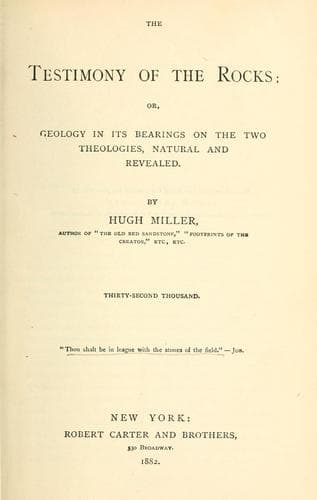
The Testimony of the Rocks: or, Geology in Its Bearings on the Two Theologies, Natural and RevealedMiller, Hugh
Philosophy
The Testimony of the Rocks: or, Geology in Its Bearings on the Two Theologies, Natural and Revealed
Miller, Hugh
Bible and geology; Creation; Religion and science
[Illustration: Fig. 119.
FUCOIDS.]
Associated with the earliest ichthyic remains of the Old Red Sandstone,
we find vegetable organisms in such abundance, that they communicate
often a fissile character to the stone in which they occur. But,
existing as mere carbonaceous markings, their state of keeping is
usually so bad, that they tell us little else than that the
antiquely-formed fishes of this remote period swam over sea bottoms
darkened by forests of algæ. The prevailing plant was one furnished with
a long, smooth stem, which, though it threw off, in the alternate order,
numerous branches at least half as stout as itself, preserved its
thickness for considerable distances without diminution,--a common
fucoidal characteristic. We find its remains mixed in the rock, though
sparingly, with those of a rough-edged plant, knobbed somewhat like the
thong-like receptacles of _Himanthalia lorea_, which also threw off
branches like the other, but diminished more rapidly. A greatly more
minute vegetable organism of the same beds, characterized by its bifid
partings, which strike off at angles of about sixty, somewhat resembles
the small-fronded variety of _Dictyota dichotoma_, save that the slim
terminations of the frond are usually bent into little hooks, like the
tendrils of the pea just as their points begin to turn. Another rather
rare plant of the period, existing as a broad, irregularly cleft frond,
somewhat resembling that of a modern _Cutleria_ or _Nitophyllum_,
betrays at once, in its outline and general appearance, its marine
origin; as does also an equally rare contemporary, which, judging from
its appearance, seems to have been a true fucus. It exists in the rock
as if simply drawn in Indian ink; for it exhibits no structure, though,
as in some of the ferns of the Coal Measures, what were once the curls
of its leaflets continue to exist as sensible hollows on the surface. It
broadens and divides atop into three or four lobes, and these, in turn,
broaden and divide into minor lobes, double or ternate, and usually
rounded at their terminations. In general appearance the plant not a
little resembles those specimens of _Fucus vesiculosus_ which we find
existing in a diminutive form, and divested of both the receptacles and
the air vessels, at the mouth of rivers. Of two other kinds of plants I
have seen only confused masses, in which the individuals were so crowded
together, and withal so fragmentary and broken, that their separate
forms could not be traced. In the one the general appearance was such as
might be produced by compressed and tangled masses of _Chorda filium_,
in which the linear and even tubular character of the plant could be
determined, but not its continuous, cord-like aspect; in the other, the
fragments seemed well nigh as slim as hairs, and the appearance was such
as might be produced by branches of that common ectocarpus, _E.
littoralis_, which may be seen on our rocky coasts roughening at low
Public-domain text, read in full here on John Shaqi.
Reviews
Reviews
No reviews yet
Be the first to share your thoughts on this work.
Elsewhere in the archive
Join the Discussion
Join the discussion
Sign in to leave a comment or review.
Sign InorCreate an account