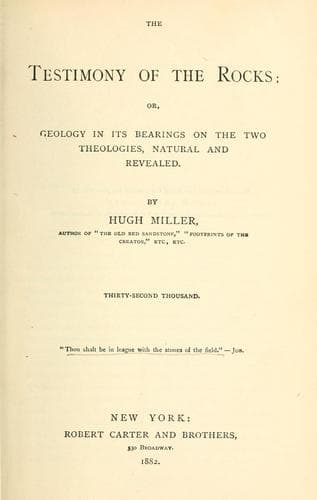
The Testimony of the Rocks: or, Geology in Its Bearings on the Two Theologies, Natural and RevealedMiller, Hugh
Philosophy
The Testimony of the Rocks: or, Geology in Its Bearings on the Two Theologies, Natural and Revealed
Miller, Hugh
Bible and geology; Creation; Religion and science
water the stems of laminaria. When highly magnified, a mesial groove
might be detected running along each of the hair-like lines. With these
marine plants we occasionally find large rectilinear stems, resolved
into a true coal, but retaining no organic character by which to
distinguish them. As I have seen some of these more than three inches in
diameter, and, though existing as mere fragments, several feet in
length, they must, if they were also plants of the sea, have exceeded in
size our largest laminaria.[46] And such are the few vegetable
organisms, of apparently aquatic origin, which I have hitherto succeeded
in detecting in the Lower Old Red Sandstone of Scotland.[47] Their
individual numbers, however, must have been very great, though, from the
destructible character of their tissues, their forms have perished in
the stone. The immensely developed flagstones of Caithness seem to owe
their dark color to organic matter mainly of vegetable origin. So
strongly bituminous, indeed, are some of the beds of dingier tint, that
they flame in the fire like slates steeped in oil.
[Illustration: Fig. 120.]
The remains of a terrestrial vegetation in this deposit are greatly
scantier than those of its marine plants; but they must be regarded as
possessing a peculiar interest, as, with the exception of the spore
cases of the Ludlow rocks, the oldest of their class, in at least the
British islands, whose true place in the scale can be satisfactorily
established. In the flagstones of Orkney there occurs, though very
rarely, a minute vegetable organism, which I have elsewhere described as
having much the appearance of one of our smaller ferns, such as the
maidenhair-spleenwort, or dwarf moonwort. It consists of a minute stem,
partially covered by what seems to be a small sheath or hollow bract,
and bifurcates into two fronds or pinnæ, fringed by from ten to twelve
leaflets, that nearly impinge on each other, and somewhat resemble in
their mode of arrangement the leaflets of one of our commonest
Aspleniums,--_Asplenium trichomanes_. One of our highest authorities,
however, in such matters (Professor Balfour of Edinburgh) questions
whether this organism be in reality a fern, and describes it from the
specimen on the table, in the Palæontological chapter of his admirable
Class Book, simply as "a remarkable pinnate frond." (Fig. 13, p. 56.) We
find it associated with the remains of a terrestrial plant allied to
lepidodendron, and which in size and general appearance not a little
resembles one of our commonest club mosses,--_Lycopodium clavatum_.[48]
It sends out its branches in exactly the same style,--some short and
simple, others branched like the parent stem,--in an arrangement
approximately alternate; and is everywhere covered, stem and branch, by
thickly set scale-like leaflets, that, suddenly narrowing, terminate in
exceedingly slim points. It has, however, proportionally a stouter stem
Public-domain text, read in full here on John Shaqi.
Reviews
Reviews
No reviews yet
Be the first to share your thoughts on this work.
Elsewhere in the archive
Join the Discussion
Join the discussion
Sign in to leave a comment or review.
Sign InorCreate an account