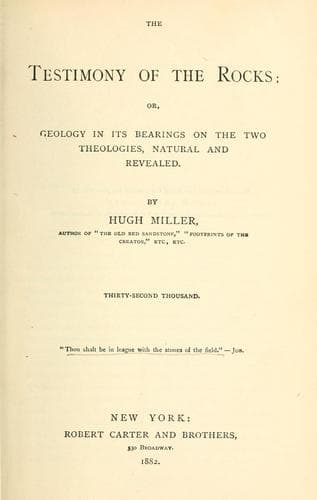
The Testimony of the Rocks: or, Geology in Its Bearings on the Two Theologies, Natural and RevealedMiller, Hugh
Philosophy
The Testimony of the Rocks: or, Geology in Its Bearings on the Two Theologies, Natural and Revealed
Miller, Hugh
Bible and geology; Creation; Religion and science
than Lycopodium; its leaves, when seen in profile, seem more rectilinear
and thin; and none of its branches yet found bear the fructiferous stalk
or spike. Its resemblance, however, to this commonest of the
Lycopodia,--a plant that may be gathered by handfuls on the moors by
which the flagstones are covered,--is close enough to suggest a new
reading of the familiar adage on the meeting of extremes. Between the
times of this ancient fossil,--one of the oldest of land plants yet
known,--and those of the existing club moss that now scatters its light
spores by millions over the dead and blackened remains of its remote
predecessor, many creations must have intervened, and many a prodigy of
the vegetable world appeared, especially in the earlier and middle
periods,--Sigillaria, Favularia, Knorria, and Ulodendron,--that have had
no representatives in the floras of latter times; and yet here, flanking
the immense scale at both its ends, do we find plants of so nearly the
same form and type, that it demands a careful survey to distinguish
their points of difference. Here, for instance, to illustrate the fact,
is there a specimen of _Lycopodium clavatum_, from one of these
Caithness moors, that agrees branch for branch, and both in the
disposition of its scales and in general outline, with the specimen in
the stone. What seems to be an early representative of the Calamites
occurs in the same beds. Some of the specimens are of large size,--at
least from nine inches to a foot in circumference,--and retain their
thickness, though existing as fragments several feet in length, with but
little diminution throughout. They resembled the interior casts of
Calamites in being longitudinally furrowed; but the furrows are flatter,
and are themselves minutely striated lengthwise by lines as fine as
hairs; and, instead of presenting any appearance of joints, there run
diagonally across the stems, interrupted and very irregular lines of
knobs. These I find referred to by Dr. Joseph Hooker, in describing a
set of massive but ill preserved remains of the same organism detected
in South Ness quarry, near Lerwick, by the Hon. Mr. Tuffnell, as taking,
in two of the specimens, "the appearance of transverse knobs and bars
(mayhap spirally arranged) that cross the striæ obliquely. But though
the knobs," he adds, "may perhaps indicate a peculiar character of the
plants, they have more probably been caused by pressure during
silicification." As, however, they also occur in the best preserved
fragment of the plant which I have yet seen,--a Thurso specimen which I
owe to my friend Mr. Dick,--I deem it best to regard them, provisionally
at least, as one of the characteristics of the plant. I may mention,
that while I disinterred one of my specimens from the Thurso flagstones,
where it occurred among remains of Dipterus and Asterolepis, I derived
another specimen from the great overlying formation of pale Red
Sandstone to which the lofty hills of Hoy and the tall mural precipices
Public-domain text, read in full here on John Shaqi.
Reviews
Reviews
No reviews yet
Be the first to share your thoughts on this work.
Elsewhere in the archive
Join the Discussion
Join the discussion
Sign in to leave a comment or review.
Sign InorCreate an account