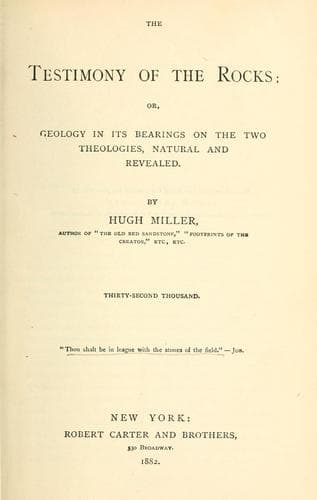
The Testimony of the Rocks: or, Geology in Its Bearings on the Two Theologies, Natural and RevealedMiller, Hugh
Philosophy
The Testimony of the Rocks: or, Geology in Its Bearings on the Two Theologies, Natural and Revealed
Miller, Hugh
Bible and geology; Creation; Religion and science
The study of plants and animals seems to have been a favorite one with
thoughtful men in every age of the world. According to the Psalmist,
these great "works of the Lord are sought out of all them that have
pleasure therein." The Book of Job, probably the oldest writing in
existence, is full of vivid descriptions of the wild denizens of the
flood and desert; and it is expressly recorded of the wise old king,
that he "spake of trees, from the cedar tree that is in Lebanon, even
unto the hyssop that springeth out of the wall; and also of beasts, and
of fowl, and of creeping things, and of fishes." Solomon was a zoologist
and botanist; and there is palpable classification in the manner in
which his studies are described. It is a law of the human mind, as has
been already said, that, wherever a large stock of facts are acquired,
the classifying principle steps in to arrange them. "Even the rudest
wanderer in the fields," says Dr. Brown, "finds that the profusion of
blossoms around him--in the greater number of which he is able himself
to discover many striking resemblances--may be reduced to some order of
arrangement." But, for many centuries, this arranging faculty labored
but to little purpose. As specimens of the strange classification that
continued to obtain down till comparatively modern times, let us select
that of two works which, from the literary celebrity of their authors,
still possess a classical standing in letters,--Cowley's "Treatise on
Plants," and Goldsmith's "History of the Earth and Animated Nature." The
plants we find arranged by the poet on the simple but very inadequate
principle of size and show. Herbs are placed first, as lowest and least
conspicuous in the scale; then flowers; and, finally, trees. Among the
herbs, at least two of the ferns--the true maidenhair and the
spleenwort--are assigned places among plants of such high standing as
sage, mint, and rosemary: among the flowers, monocotyledons, such as the
iris, the tulip, and the lily, appear among dicotyledons, such as the
rose, the violet, the sunflower, and the auricula: and among trees we
find the palms placed between the plum and the olive; and the yew, the
fir, and the juniper, flanked on one side by the box and the holly, and
on the other by the oak. Such, in treating of plants, was the
classification adopted by one of the most learned of English poets in
the year 1657.
Public-domain text, read in full here on John Shaqi.
Reviews
Reviews
No reviews yet
Be the first to share your thoughts on this work.
Join the Discussion
Join the discussion
Sign in to leave a comment or review.
Sign InorCreate an account