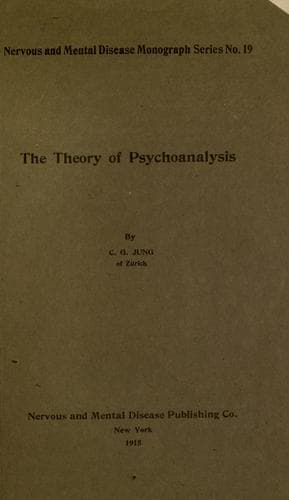
The Theory of PsychoanalysisJung, C. G. (Carl Gustav)
Science
The Theory of Psychoanalysis
Jung, C. G. (Carl Gustav)
Neuroses; Psychoanalysis; Psychology, Pathological; Sex
I informed the mother, who came to consult me, that these things were
neurotic signs, and that some special circumstance must be hidden there,
necessitating an interrogation of the child. This supposition was not
arbitrary, for every attentive observer knows that if children are
restless or in bad temper, there is always something painful worrying
them. If it were not painful, they would tell it, and they would not be
worried over it. Of course, I am only speaking of those cases having a
psychogenic cause. The child confessed to her mother the following
story: She had a favorite teacher, of whom she was very fond. During
this last term she had fallen back somewhat, through working
insufficiently, and she believed she had rather fallen in the estimation
of her teacher. She then began to feel sick during his lessons. She felt
not only estranged from her teacher, but even somewhat hostile. She
directed all her friendly feelings to a poor boy with whom she usually
shared the bread which she took to school. Later on she gave him money,
so that he could buy bread for himself. In a conversation with this boy
she made fun of her teacher and called him a goat. The boy attached
himself more and more to her, and considered that he had the right to
levy a tax on her occasionally in the form of a little present of money.
She now became greatly alarmed lest the boy might tell her teacher that
she turned him into ridicule and called him a “goat,” and she promised
him two francs if he would give his solemn word never to tell anything
to her teacher. From that moment the boy began to exploit her; he
demanded money with threats and persecuted her with his demands on the
way to school. This made her perfectly miserable. Her attacks of
sickness are closely connected with all this story. But after the affair
had been disposed of by this confession, her peace of mind was not
restored as might have been expected.
We very often see, as I have said, that the mere relation of a painful
affair can have an important therapeutical effect. Generally this does
not last very long, although on occasion such a favorable effect can
maintain itself for a long time. Such a confession is naturally a long
way from being an analysis. But there are nerve-specialists nowadays who
believe that an analysis is only a somewhat more extensive anamnesis or
confession.
A little while later the child had an attack of coughing and missed
school for one day. After that she went to school for one day and felt
perfectly well. On the third day, a renewed attack of coughing came on,
with pains on the left side, fever and vomiting. Her temperature,
accurately taken, showed 39.4° C., about 103° F. The doctor feared
pneumonia. But the next day everything had passed away. She felt quite
well and not the slightest sign of fever or sickness was to be noted.
Public-domain text, read in full here on John Shaqi.
Reviews
Reviews
No reviews yet
Be the first to share your thoughts on this work.
Elsewhere in the archive
Join the Discussion
Join the discussion
Sign in to leave a comment or review.
Sign InorCreate an account