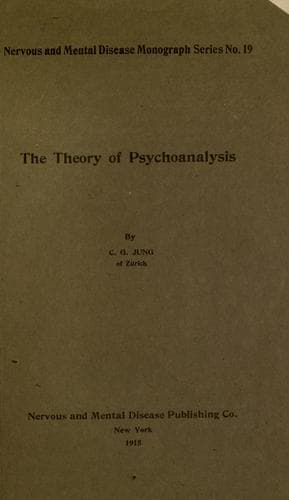
The Theory of PsychoanalysisJung, C. G. (Carl Gustav)
Science
The Theory of Psychoanalysis
Jung, C. G. (Carl Gustav)
Neuroses; Psychoanalysis; Psychology, Pathological; Sex
But still our little patient wept the whole time and did not wish to get
up. From this strange course of events I suspected some serious
neurosis, and I therefore advised treatment by analysis.
Analytic Treatment
First interview: The little girl seemed to be nervous and constrained,
having a disagreeable forced laugh. Miss Moltzer, who analyzed her, gave
her first of all an opportunity of talking about her staying in bed. We
learn that she liked it immensely, as she always had some society.
Everybody came to see her; also her mother read to her out of a book
which contained the story of _a prince who was ill, but who recovered
when his wish was fulfilled, the wish being that his little friend, a
poor boy, might be allowed to stay with him_.
The obvious relation between this story and her own little love-story,
as well as its connection with her own illness, was pointed out to her,
whereupon she began to cry and say she would prefer to go to the other
children and play with them, otherwise they would run off. This was at
once allowed, and away she ran, but came back again, after a short
while, somewhat embarrassed. It was explained to her that she did not
run away because she was afraid her playmates would go, but that she
herself wanted to get off because of resistances.
At the second interview she was less anxious and repressed. They
happened to speak about the teacher, but then she was embarrassed. She
seemed to be ashamed at the end, and she timidly confessed that she
liked her teacher very much. It was then explained to her that she need
not be ashamed of that; on the contrary, her love for him could be a
valuable stimulus to make her do her very best in his lessons. “So I may
love him?” asked the little patient with a happier face.
This explanation justified the child in the choice of the object of her
affection. It seems as if she had been ashamed of admitting her feelings
for her teacher. It is not easy to explain why this should be so. Our
present conception tells us that the libido has great difficulty in
taking hold of a personality outside the family, because it still finds
itself in incestuous bonds,—a very plausible view indeed, from which it
is difficult to withdraw. But we must point out here that her libido was
placed with much intensity upon the poor boy, who was also someone
outside the family; whence we must conclude that the difficulty was not
to be found in the transference of the libido outside the family, but in
some other circumstance. The love of the teacher betokens a difficult
task; it demands much more than her love for the little boy, which does
not require any moral effort on her part. This indication in the
analysis that her love for her teacher would enable her to do her utmost
brings the child back to her real duty, namely, her adaptation to her
teacher.
Public-domain text, read in full here on John Shaqi.
Reviews
Reviews
No reviews yet
Be the first to share your thoughts on this work.
Elsewhere in the archive
Join the Discussion
Join the discussion
Sign in to leave a comment or review.
Sign InorCreate an account