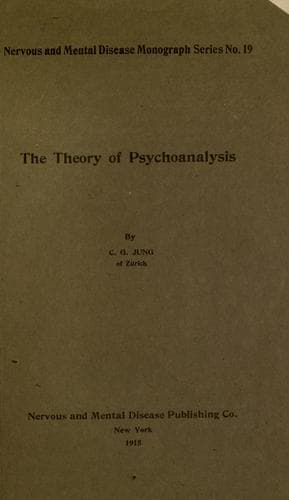
The Theory of PsychoanalysisJung, C. G. (Carl Gustav)
Science
The Theory of Psychoanalysis
Jung, C. G. (Carl Gustav)
Neuroses; Psychoanalysis; Psychology, Pathological; Sex
The conversation ran on to the story of the extortion, which is now
again told in details. We hear further that she had tried to force open
her savings-bank, and as she could not succeed in doing so, she wanted
to steal the key from her mother. She expressed herself thus about the
whole matter: she ridiculed her teacher because he was much kinder to
the other girls than to her. But it was true that she did not do very
well in his lessons, especially at arithmetic. Once she did not
understand something, was afraid to ask, for fear she might lose his
esteem, and consequently she made many mistakes and did really lose it.
It is pretty clear that her position towards her teacher became
consequently very unsatisfactory. About this time it happened that a
young girl in her class was sent home because she was sick. Soon after,
the same thing happened to herself. In this way, she tried to get away
from the school which had become uncongenial to her. The loss of her
teacher’s respect led her on the one hand to insult him and on the other
into the affair with the little boy, obviously as a compensation for the
lost relationship with the teacher. The explanation which was given here
was a simple hint: she would be rendering a service to her teacher if
she took pains to understand the lessons by sensible questions.
I can add here that this hint, given in the analysis, had a good effect;
from that moment the little girl became one of the best of pupils, and
missed no more arithmetic lessons.
We must call attention to the fact that the story of the boy’s extortion
shows constraint and a lack of freedom. This phenomenon exactly follows
the rule. As soon as anyone permits his libido to draw back from
necessary tasks, it becomes autonomous and chooses, without regard to
the protests of the subject, its own way, and pursues it obstinately. It
is a general fact, that a lazy and inactive life is highly susceptible
to the _coercion of the libido_, that is to say, to all kinds of terrors
and involuntary obligations. The anxieties and superstitions of savages
furnish us with the best illustrations; but our own history of
civilization, especially the civilization and customs of the ancients,
abounds with confirmations. Non-employment of the libido makes it
autonomous, but we must not believe either that we are able to save
ourselves permanently from the coercion of the libido by making forced
efforts. To a certain limited extent we are able to set conscious tasks
to our libido, but other natural tasks are chosen by the libido itself,
and that is what the libido exists for. If we avoid those tasks, the
most active life can become useless, for we have to deal with the whole
of the conditions of our human nature. Innumerable cases of neurasthenia
from overwork can be traced back to this cause, for work done amid
internal conflicts creates nervous exhaustion.
Public-domain text, read in full here on John Shaqi.
Reviews
Reviews
No reviews yet
Be the first to share your thoughts on this work.
Elsewhere in the archive
Join the Discussion
Join the discussion
Sign in to leave a comment or review.
Sign InorCreate an account