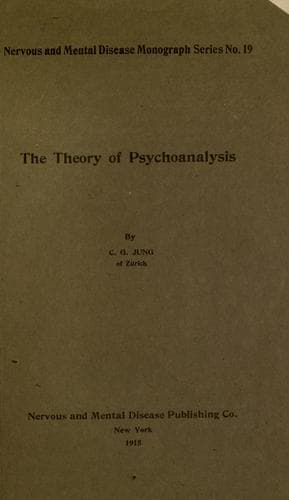
The Theory of PsychoanalysisJung, C. G. (Carl Gustav)
Science
The Theory of Psychoanalysis
Jung, C. G. (Carl Gustav)
Neuroses; Psychoanalysis; Psychology, Pathological; Sex
The libido retires from before such a necessary task, for the very human
reason of indolence, which is highly developed, not only in children,
but also in primitive people. Primitive laziness and indolence are the
first resistances to the efforts towards adaptation. The libido which is
not used for this purpose becomes stagnant and will make the inevitable
regression to former objects or modes of employment. It is thus that the
incest-complex is revived in such a striking way. The libido avoids the
object which is so difficult to attain and demands such great efforts,
and turns towards the easier ones, and finally to the easiest of all,
namely, the infantile phantasies, which thus become real
incest-phantasies. The fact that, wherever there is present a
disturbance of psychological adaptation, one finds an exaggerated
development of incest-phantasies, must be conceived, as I have pointed
out, as a regressive phenomenon. That is to say, the incest-phantasy is
of secondary and not of causal significance, while the primary cause is
the resistance of human nature against any kind of exertion. The drawing
back from certain duties is not to be explained by saying that man
prefers the incestuous condition, but he has to fall back into it,
because he shuns exertion; otherwise it would have to be said that the
aversion from conscious effort must be taken as identical with the
preference for incestuous relations. This would be obvious nonsense, for
not only primitive man, but animals too, have a pronounced dislike for
all intentional efforts, and pay homage to absolute laziness, until
circumstances force them into action. We cannot pretend, either in very
primitive people or in animals, that their preference for incestuous
relations causes aversion towards efforts of adaptation, as in those
cases there can be no question of “incestuous” relations. This would
presuppose a differentiation of parents and non-parents.
Characteristically, the child expressed her joy at being allowed to love
her teacher, but not at being allowed to do her utmost for him. That she
might love her teacher is what she understood at once, because it suited
her best. Her relief was caused by the information that she was right in
loving him, even though she did not especially exert herself before.
Public-domain text, read in full here on John Shaqi.
Reviews
Reviews
No reviews yet
Be the first to share your thoughts on this work.
Elsewhere in the archive
Join the Discussion
Join the discussion
Sign in to leave a comment or review.
Sign InorCreate an account