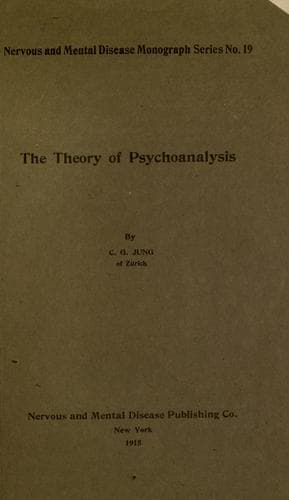
The Theory of PsychoanalysisJung, C. G. (Carl Gustav)
Science
The Theory of Psychoanalysis
Jung, C. G. (Carl Gustav)
Neuroses; Psychoanalysis; Psychology, Pathological; Sex
Freud himself abandoned his first presentation of the shock-theory after
further and more thorough investigation. He could no longer retain his
original view as to the reality of the sexual shock. Excessive
sexuality, sexual abuse of children, or very early sexual activity in
childhood, were later on seen to be of secondary importance. You will
perhaps be inclined to share the suspicion of the critics that the
results derived from analytic researches were based on suggestion. There
might be some justification for this view if these assertions had been
published broadcast by some charlatan or ill-qualified person. But
anyone who has carefully read Freud’s works, and has himself similarly
sought to penetrate into the psychology of his patients, will know that
it is unjust to attribute to an intellect like Freud’s the crude
mistakes of a journeyman. Such suggestions only redound to the discredit
of those who make them. Ever since then patients have been examined by
every possible means from which suggestion could be absolutely excluded.
And still the associations described by Freud have been proved to be
true in principle. We are thus obliged in the first place to regard many
of these shocks of early childhood as phantoms, while other traumata
have objective reality. With this knowledge, at first somewhat
confusing, the etiological importance of the sexual trauma in childhood
declines, as it seems now quite irrelevant whether the trauma really
took place or not. Experience teaches us that phantasy can be, so to
speak, of the same traumatic value as real shock. In the face of such
facts, every physician who treats hysteria will recall cases where the
neurosis has indeed been provoked by violent traumatic impressions. This
observation is only in apparent contradiction with our knowledge,
already referred to, of the unreality of traumatic events in childhood.
We know perfectly well that many persons suffer shocks in childhood or
in adult life who nevertheless get no neurosis. Therefore the trauma
has, ceteris paribus, no absolute etiological importance, but owes its
efficacy to the nature of the soil upon which it falls.
The Predisposition for the Trauma
No neurosis will grow on an unprepared soil where no germ of neurosis is
already existing; the trauma will pass by without leaving any permanent
and effective mark. From this simple consideration it is pretty clear
that, to make it really effective, the patient must meet the shock with
a certain internal predisposition. This internal predisposition is not
to be understood as meaning that totally obscure hereditary
predisposition of which we know so little, but as a psychological
development which reaches its apogee and its manifestation at the
moment, and even through, the trauma.
Public-domain text, read in full here on John Shaqi.
Reviews
Reviews
No reviews yet
Be the first to share your thoughts on this work.
Join the Discussion
Join the discussion
Sign in to leave a comment or review.
Sign InorCreate an account