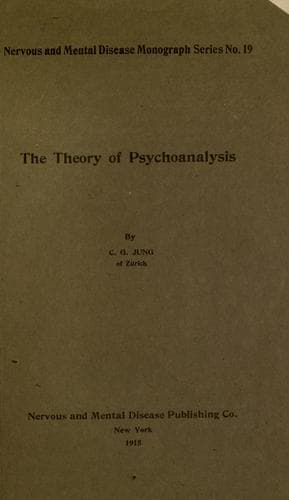
The Theory of PsychoanalysisJung, C. G. (Carl Gustav)
Science
The Theory of Psychoanalysis
Jung, C. G. (Carl Gustav)
Neuroses; Psychoanalysis; Psychology, Pathological; Sex
We found, behind the neurotic symptoms, complicated emotional processes,
which were undoubtedly connected with the symptoms. If it may be allowed
to draw some general conclusions from this limited material, we could
construct the course of the neurosis in the following way.
At the gradual approach of puberty, the libido of the child assumed
rather an emotional than a practical attitude towards reality. She began
to be very much taken with her teacher, but the sentimental
self-indulgence, evinced in her riotous phantasies, played a greater
part than the thought of the increased endeavors which such love ought
really to have demanded of her. For this reason, her attention and her
work left much to be desired. The former pleasant relationship with her
favorite teacher was troubled. The teacher was annoyed, and the little
girl, who had been made somewhat conceited by her home-conditions, was
resentful, instead of trying to improve in her work. In consequence her
libido withdrew from her teacher, as well as from her work, and fell
into the characteristic forced dependence on the little boy, who on his
side made the most of the situation. Then the resistances against school
seized the first opportunity, which was suggested by the case of the
little girl who had to be sent home on account of sickness. Our little
patient followed this child’s example. Once away from school, the way
was open to her phantasies. By the regression of the libido, these
symptom-making phantasies became awakened to a real activity, and were
given an importance they had never had before, for they had never
previously played such an important part. Now they become apparently of
much importance and seemed to be the very reason why the libido
regressed to them. It might be said that the child, in consequence of
its essentially phantasy-building nature, saw her father too much in her
teacher, and thus developed incestuous resistances towards the latter.
As I have already stated, I hold that it is simpler and more probable to
accept the view that, during a certain period, it was convenient for her
to see the teacher as the father. As she preferred to follow the hidden
presentiments of puberty rather than her duties towards the school and
her teacher, she allowed her libido to fall on the little boy, from
whom, as we saw, she awaited some mysterious advantages. Even if
analysis had demonstrated it as a fact that she had had incestuous
resistances against her teacher on account of the transference of the
father-image, those resistances would only have been secondary
phantasies, that had become inflated. At any rate, indolence would still
have been the primum movens. In the analysis she learned about the two
ways of life, the way of phantasy, of regression, and the way of
reality, wherein lay her present child’s duties. In her the two were
dissociated, and consequently she was at strife with herself. As the
analysis was adapted to the regressive tendency of the libido, the
Public-domain text, read in full here on John Shaqi.
Reviews
Reviews
No reviews yet
Be the first to share your thoughts on this work.
Elsewhere in the archive
Join the Discussion
Join the discussion
Sign in to leave a comment or review.
Sign InorCreate an account