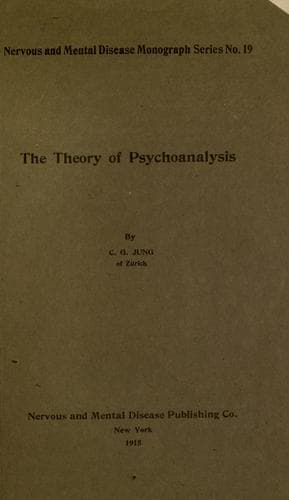
The Theory of PsychoanalysisJung, C. G. (Carl Gustav)
Science
The Theory of Psychoanalysis
Jung, C. G. (Carl Gustav)
Neuroses; Psychoanalysis; Psychology, Pathological; Sex
existence of an extreme sexual curiosity, connected with certain very
definite problems, was discovered. The libido, imprisoned in this
phantastical labyrinth, was brought back into useful application by
means of the psychological explanation of the incorrect infantile
phantasies. The child thus got an insight into her own attitude towards
reality with all its possibilities. The result was that she was able to
take an objective-critical attitude towards her immature
puberty-desires, and was able to give up these and all other
impossibilities in favor of the use of her libido in possible
directions, in her work and in obtaining the good-will of her teacher.
In this case, analysis brought great peace of mind, as well as a
pronounced intellectual improvement. After a short time her teacher
himself stated that the little girl was one of the best pupils in her
class.
I hope that by the exposition of this brief instance of the course of an
analysis, I have succeeded in giving you an insight not only into the
concrete procedure of treatment, and into the technical difficulties,
but no less into the beauty of the human mind and its endless problems.
I intentionally brought into prominence the parallelism with mythology,
to indicate the universally possible applications of psychoanalysis. At
the same time, I should like to refer to the further importance of this
position. We may see in the predominance of the mythological in the mind
of a child, a distinct hint of the gradual development of the individual
mind out of the collective knowledge or the collective feeling of
earliest childhood, which gave rise to the old theory of a condition of
perfect knowledge before and after individual existence.
In the same way we might see, in the marvellous analogy between the
phantasies of dementia præcox and mythological symbolisms, a reason for
the widespread superstition that an insane person is possessed of a
demon, and has some divine knowledge.
With these hints, I have reached the present standpoint of
investigation, and I have at least sketched those facts and working
hypotheses which are characteristic for my present and future work.
Footnote 11:
“Wandlungen und Symbole der Libido,” Wien, 1912.
Footnote 12:
Abraham, “Dreams and Myths,” No. 15 of the Monograph Series.
Footnote 13:
“Dreams and Myths,” No. 15 of the Monograph Series.
INDEX
Abreagieren, 5
Actual conflict, 92, 93
Actual present, 81
Adaptation, failure of, 83
Amnesia, infantile, 78
Analysis of dreams, 60, 109
Analysis of transference, 105
Association-experiment, 66
Breuer, 5
Cathartic method, 6
Change in the theory of psychoanalysis, 5
Charcot, 5
Child, neurosis in, 113
Childhood, sexual trauma in, 10
Complex, Electra, 69
Complex, Oedipus, 67
Complex, incest, 70
Complex of the parents, 50
Conception of libido, 27
Conception of sensitiveness, 89
Conception of sexuality, 19
Public-domain text, read in full here on John Shaqi.
Reviews
Reviews
No reviews yet
Be the first to share your thoughts on this work.
Elsewhere in the archive
Join the Discussion
Join the discussion
Sign in to leave a comment or review.
Sign InorCreate an account