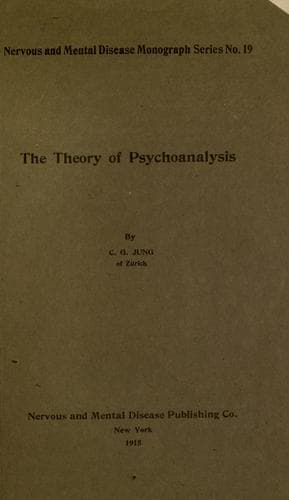
The Theory of PsychoanalysisJung, C. G. (Carl Gustav)
Science
The Theory of Psychoanalysis
Jung, C. G. (Carl Gustav)
Neuroses; Psychoanalysis; Psychology, Pathological; Sex
It is unnecessary to prove that such an event must leave a lasting
impression behind. But still it does not offer any explanation for the
exaggerated reaction to an inadequate stimulus. Up till now we only know
that this later symptom had its prologue in childhood, but the
pathological side remains obscure. To solve this enigma we require other
experiences. The amnesia which I will set forth fully later on shows
clearly the disproportion between the so-called shock and the part
played by phantasy. In this case phantasy must predominate to an
extraordinary extent to provoke such an effect. The shock in itself was
too insignificant. We are at first inclined to explain this incident by
the shock that took place in childhood, but it seems to me with little
success. It is difficult to understand why the effect of this infantile
trauma had remained latent so long, and why it only now came to the
surface. The patient must surely have had opportunities enough during
her lifetime of getting out of the way of a carriage going full speed.
The reminiscence of the danger to her life seems to be quite
insufficiently effective: the real danger in which she was at that one
moment in St. Petersburg did not produce the slightest trace of
neurosis, despite her being predisposed by an impressive event in her
childhood. The whole of this traumatic event still lacks explanation;
from the point of view of the shock-theory we are hopelessly in the
dark.
You must excuse me if I return so persistently to the shock-theory. I
consider this necessary, as now-a-days many people, even those who
regard us seriously, still keep to this standpoint. Thus the opponents
to psychoanalysis and those who never read psychoanalytic articles, or
do so quite superficially, get the impression that in psychoanalysis the
old shock-theory is still in force.
The question arises: what are we to understand by this predisposition,
through which an insignificant event produces such a pathological
effect? This is the question of chief significance, and we shall find
that the same question plays an important rôle in the theory of
neurosis, for we have to understand why apparently irrelevant events of
the past are still producing such effects that they are able to
interfere in an impish and capricious way with the normal reactions of
actual life.
The Sexual Element in the Trauma
Public-domain text, read in full here on John Shaqi.
Reviews
Reviews
No reviews yet
Be the first to share your thoughts on this work.
Join the Discussion
Join the discussion
Sign in to leave a comment or review.
Sign InorCreate an account