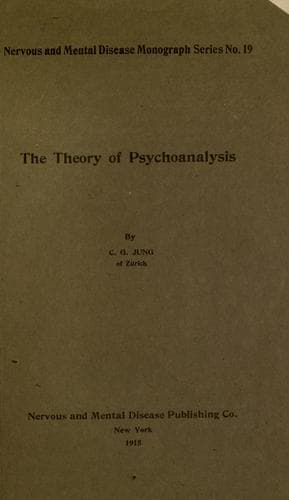
The Theory of PsychoanalysisJung, C. G. (Carl Gustav)
Science
The Theory of Psychoanalysis
Jung, C. G. (Carl Gustav)
Neuroses; Psychoanalysis; Psychology, Pathological; Sex
Experience tells us nothing about this. There have been some small
traces of influences of this kind, but of such slight intensity that
they cannot be compared with the intensity of the former homo-sexual
component. On the conception that has been outlined, it is also
incomprehensible how this homo-sexual component, regarded as so firmly
fixed, can ever disappear without leaving active traces. To explain
things, the process of development is called in, forgetting that this is
only a word and explains nothing. You see, therefore, the urgent
necessity of an adequate explanation of such a change of scene. For this
we must have a dynamic hypothesis. Such commutations are only
conceivable as dynamic or energic processes. I cannot conceive how
manifestations of functions can disappear if I do not accept a change in
the relation of one force to another. Freud’s theory did have regard to
this necessity in the conception of components. The presumption of
isolated functions existing side by side began to be somewhat weakened,
more in practice than theoretically. It was replaced by an energic
conception. The term chosen for this conception is “libido.”
Footnote 4:
No. 7 of this Monograph Series.
CHAPTER III
The Conception of Libido
Freud had already introduced the idea of libido in his[5] “Three
Contributions to the Sexual Theory” in the following words:
“In biology, the fact that both mankind and animals have a sexual want
is expressed by the conception of the sexual desire. This is done by
analogy with the want of nourishment, so-called hunger. Popular speech
has no corresponding characterization for the word ‘hunger,’ and so
science uses the word ‘libido.’”
In Freud’s definition, the term “libido” appears as exclusively a sexual
desire. “Libido” as a medical term is certainly used for sexual desire,
and especially for sexual lust. But the classical definition of this
word as found in Cicero, Sallust, and others, was not so exclusive. The
word is there used in a more general sense for every passionate desire.
I only just mention this definition here, as further on it plays an
important part in our considerations, and as it is important to know
that the term “libido” has really a much wider meaning than is
associated with it through medical language.
Public-domain text, read in full here on John Shaqi.
Reviews
Reviews
No reviews yet
Be the first to share your thoughts on this work.
Join the Discussion
Join the discussion
Sign in to leave a comment or review.
Sign InorCreate an account