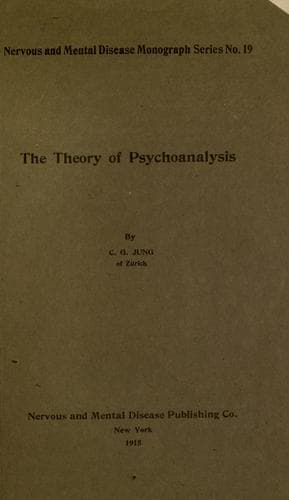
The Theory of PsychoanalysisJung, C. G. (Carl Gustav)
Science
The Theory of Psychoanalysis
Jung, C. G. (Carl Gustav)
Neuroses; Psychoanalysis; Psychology, Pathological; Sex
I believe such an objection is justified. There is really a considerable
difference between immature and fully developed functions, as there is a
difference between play and reality, between shooting with blank and
with loaded cartridges. That the childish libido has the harmlessness
demanded by common sense cannot be contested. But of course none can
deny that blank shooting is shooting. We must get accustomed to the idea
that sexuality really exists, even before puberty, right back in early
childhood, and that we have no right to pretend that manifestations of
this immature sexuality are not sexual. This does not indeed refute the
objection, which, while recognizing the existence of infantile sexuality
in the form already described, yet denies Freud’s claim to regard as
sexual early infantile manifestations such as sucking. We have mentioned
already the motives which induced Freud to enlarge the sexual
terminology in such a way. We mentioned, too, how this very act of
sucking, for instance, could be conceived from the standpoint of
pleasure in the function of nutrition, and that, on biological grounds,
there was more justification for this derivation than for Freud’s view.
It might be objected that these and similar activities of the oral zones
are found in later life in an undoubted sexual use. This only means that
these activities can in later life be used for sexual purposes, but that
does not tell us anything concerning the primitive sexual nature of
these forms. I must, therefore, admit that I find no ground for
regarding the activities of the suckling, which provoke pleasure and
satisfaction, from the standpoint of sexuality. Indeed there are many
objections against this conception. It seems to me, in so far as I am
capable of judging these difficult problems, that from the standpoint of
sexuality it is necessary to divide human life into three phases.
The Three Phases of Life
The first phase embraces the first years of life. I call this part of
life the pre-sexual stage. These years correspond to the
caterpillar-stage of butterflies, and are characterized almost
exclusively by the functions of nutrition and growth.
The second phase embraces the later years of childhood up to puberty,
and might be called the pre-pubertal stage.
The third phase is that of riper years, proceeding only from puberty
onwards, and could be called the time of maturity.
Public-domain text, read in full here on John Shaqi.
Reviews
Reviews
No reviews yet
Be the first to share your thoughts on this work.
Join the Discussion
Join the discussion
Sign in to leave a comment or review.
Sign InorCreate an account