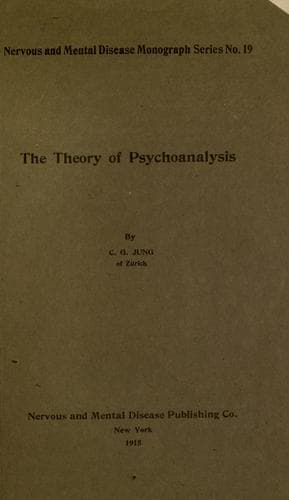
The Theory of PsychoanalysisJung, C. G. (Carl Gustav)
Science
The Theory of Psychoanalysis
Jung, C. G. (Carl Gustav)
Neuroses; Psychoanalysis; Psychology, Pathological; Sex
From the genetic standpoint it is otherwise. It regards the multiplicity
of instincts as issuing out of relative unity, the primitive libido. It
recognizes that definite quantities of the primitive libido are split
off, associated with the recently created functions, and finally merged
in them. From this standpoint we can say, without any difficulty, that
patients with dementia præcox withdraw their “libido” from the external
world and in consequence suffer a loss of reality, which is compensated
by an increase of the phantasy-building activities.
We must now fit the new conception of libido into that theory of
sexuality in childhood which is of such great importance in the theory
of neurosis. Generally speaking, we first find the libido as the energy
of vital activities acting in the zone of the function of nutrition.
Through the rhythmical movements in the act of sucking, nourishment is
taken with all signs of satisfaction. As the individual grows and his
organs develop, the libido creates new ways of desire, new activities
and satisfactions. Now the original model—rhythmic activity, creating
pleasure and satisfaction—must be transferred to other functions which
have their final goal in sexuality.
This transition is not made suddenly at puberty, but it takes place
gradually throughout the course of the greater part of childhood. The
libido can only very slowly and with great difficulty detach itself from
the characteristics of the function of nutrition, in order to pass over
into the characteristics of sexual function. As far as I can see, we
have two epochs during this transition, the epoch of _sucking_ and the
epoch of the _displaced rhythmic activity_. Considered solely from the
point of view of its mode of action, sucking clings entirely to the
domain of the function of nutrition, but it presents also a far wider
aspect, it is no mere function of nutrition, it is a rhythmical
activity, with its goal in a pleasure and satisfaction of its own,
distinct from the obtaining of nourishment. The hand comes into play as
an accessory organ. In the epoch of the displaced rhythmical activity it
stands out still more as an accessory organ, when the oral zone ceases
to give pleasure, which must now be obtained in other directions. The
possibilities are many. As a rule the other openings of the body become
the first objects of interest of the libido; then follow the skin in
general and certain places of predilection upon it.
Public-domain text, read in full here on John Shaqi.
Reviews
Reviews
No reviews yet
Be the first to share your thoughts on this work.
Join the Discussion
Join the discussion
Sign in to leave a comment or review.
Sign InorCreate an account