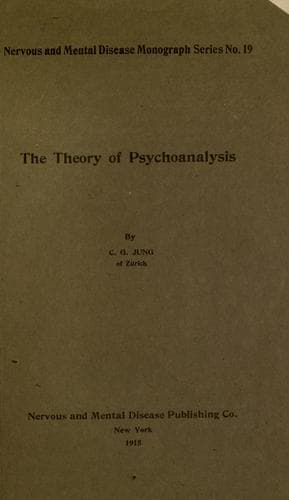
The Theory of PsychoanalysisJung, C. G. (Carl Gustav)
Science
The Theory of Psychoanalysis
Jung, C. G. (Carl Gustav)
Neuroses; Psychoanalysis; Psychology, Pathological; Sex
It is not an easy task to speak about psychoanalysis in these days. I am
not thinking, when I say this, of the fact that psychoanalysis in
general—it is my earnest conviction—is among the most difficult
scientific problems of the day. But even when we put this cardinal fact
aside, we find many serious difficulties which interfere with the clear
interpretation of the matter. I am not capable of giving you a complete
doctrine elaborated both from the theoretical and the empirical
standpoint. Psychoanalysis has not yet reached such a point of
development, although a great amount of labor has been expended upon it.
Neither can I give you a description of its growth ab ovo, for you
already have in your country, with its great regard for all the progress
of civilization, a considerable literature on the subject. This
literature has already spread a general knowledge of psychoanalysis
among those who have a scientific interest in it.
You have had the opportunity of listening to Freud, the real explorer
and founder of this method, who has spoken in your own country about
this theory. As for myself, I have already had the honor of speaking
about this work in America. I have discussed the experimental foundation
of the theory of complexes and the application of psychoanalysis to
pedagogy.
It can be easily understood that under these circumstances I fear to
repeat what has already been said, or published in many scientific
journals in this country. A further difficulty lies in the fact that in
very many quarters there are already prevailing quite extraordinary
conceptions of our theory, conceptions which are often absolutely wrong,
and unfortunately wrong just in that which touches the very essence of
psychoanalysis. At times it seems nearly impossible to grasp even the
meaning of these errors, and I am constantly astonished to find any one
with a scientific education ever arriving at ideas so divorced from all
foundations in fact. Obviously it would be of no importance to cite
examples of these curiosities, and it will be more valuable to discuss
here those questions and problems of psychoanalysis which really might
provoke misunderstanding.
A Change in the Theory of Psychoanalysis
Public-domain text, read in full here on John Shaqi.
Reviews
Reviews
No reviews yet
Be the first to share your thoughts on this work.
Join the Discussion
Join the discussion
Sign in to leave a comment or review.
Sign InorCreate an account