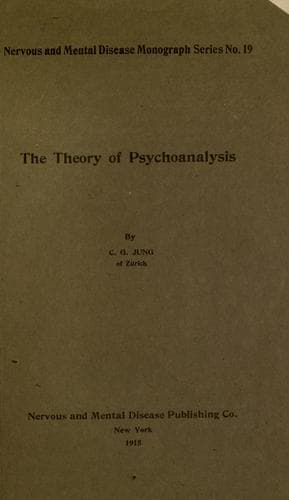
The Theory of PsychoanalysisJung, C. G. (Carl Gustav)
Science
The Theory of Psychoanalysis
Jung, C. G. (Carl Gustav)
Neuroses; Psychoanalysis; Psychology, Pathological; Sex
Unfortunately the reality is much more complicated. Let me facilitate an
insight into these complications by an example of a case of hysteria. It
will, I hope, enable me to demonstrate the characteristic complication,
so important for the theory of neurosis. You will probably remember the
case of the young lady with hysteria, whom I mentioned at the beginning
of my lectures. We noticed the remarkable fact that this patient was
unaffected by situations which one might have expected to make a
profound impression and yet showed an unexpected extreme pathological
reaction to a quite everyday event. We took this occasion to express our
doubt as to the etiological significance of the shock, and to
investigate the so-called predisposition which rendered the trauma
effective. The result of that investigation led us to what has just been
mentioned, that it is by no means improbable that the origin of the
neurosis is due to a retardation of the affective development.
You will now ask me what is to be understood by the retardation of the
affectivity of this hysteric. The patient lives in a world of phantasy,
which can only be regarded as infantile. It is unnecessary to give a
description of these phantasies, for you, as neurologists or
psychiatrists, have the opportunity daily to listen to the childish
prejudices, illusions and emotional pretensions to which neurotic people
give way. The disinclination to face stern reality is the distinguishing
trait of these phantasies—some lack of earnestness, some trifling, which
sometimes hides real difficulties in a light-hearted manner, at others
exaggerates trifles into great troubles. We recognize at once that
inadequate psychic attitude towards reality which characterizes the
child, its wavering opinions and its deficient orientation in matters of
the external world. With such an infantile mental disposition all kinds
of desires, phantasies and illusions can grow luxuriantly, and this we
have to regard as the critical causation. Through such phantasies people
slip into an unreal attitude, preeminently ill-adapted to the world,
which is bound some day to lead to a catastrophe. When we trace back the
infantile phantasy of the patient to her earliest childhood we find, it
is true, many distinct, outstanding scenes which might well serve to
provide fresh food for this or that variation in phantasy, but it would
be vain to search for the so-called traumatic motive, whence something
abnormal might have sprung, such an abnormal activity, let us say, as
day-dreaming itself. There are certainly to be found traumatic scenes,
although not in earliest childhood; the few scenes of earliest childhood
which were remembered seem not to be traumatic, being rather accidental
events, which passed by without leaving any effect on her phantasy worth
mentioning. The earliest phantasies arose out of all sorts of vague and
only partly understood impressions received from her parents. Many
Public-domain text, read in full here on John Shaqi.
Reviews
Reviews
No reviews yet
Be the first to share your thoughts on this work.
Join the Discussion
Join the discussion
Sign in to leave a comment or review.
Sign InorCreate an account