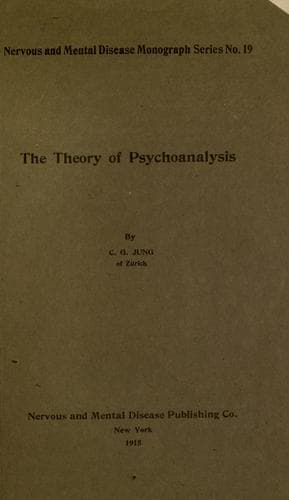
The Theory of PsychoanalysisJung, C. G. (Carl Gustav)
Science
The Theory of Psychoanalysis
Jung, C. G. (Carl Gustav)
Neuroses; Psychoanalysis; Psychology, Pathological; Sex
We can now understand why that moment was pathogenic, as well as why it
chose those particular symbols. Through the conception of regression,
the theory is freed from the narrow formula of the importance of the
events in childhood, and the actual conflict thus gets that significance
which, from an empirical standpoint, belongs to it implicitly. Freud
himself introduced the conception of regression in his “Three
Contributions,” acknowledging rightly that our observations do not
permit us to seek the cause of neurosis exclusively in the past. If it
is true, then, that reminiscent matter becomes active again as a rule by
regression, we have to consider the following question: Have, perhaps,
the apparent effective results of reminiscences to be referred in
general to a regression of the libido? As I said before, Freud suggested
in his “Three Contributions,” that the infantilism of neurotic sexuality
was, _for the greater part, due to the regression of the libido_. This
statement deserves greater prominence than it there received. Freud did
give it this prominence in his later works to a somewhat greater extent.
The recognition of the regression of the libido very largely reduces the
etiological significance of the events of childhood. It has already
seemed to us rather astonishing that the Œdipus- or the Electra-complex
should have a determining value in regard to the onset of a neurosis,
since these complexes exist in everyone. They exist even with those
persons who have never known their own father and mother, but have been
educated by their step-parents. I have analyzed cases of this kind, and
found that the incest-complex was as well developed as in other
patients. It seems to us that this is good proof that the incest-complex
is much more a purely regressive production of phantasies than a
reality. From this standpoint, the events in childhood are only
significant for the neuroses in so far as they are revived later through
a regression of the libido. That this must be true to a great extent is
also shown by the fact that the infantile sexual shock never causes
hysteria, nor does the incest-complex, which is common to everyone. The
neurosis only begins as soon as the incest-complex becomes actuated by
regression.
Public-domain text, read in full here on John Shaqi.
Reviews
Reviews
No reviews yet
Be the first to share your thoughts on this work.
Elsewhere in the archive
Join the Discussion
Join the discussion
Sign in to leave a comment or review.
Sign InorCreate an account