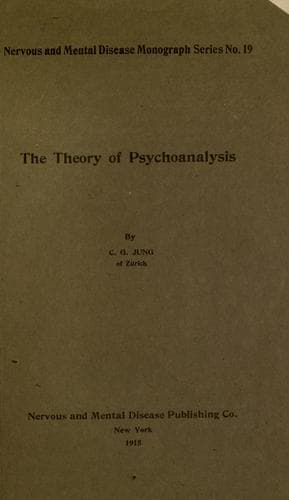
The Theory of PsychoanalysisJung, C. G. (Carl Gustav)
Science
The Theory of Psychoanalysis
Jung, C. G. (Carl Gustav)
Neuroses; Psychoanalysis; Psychology, Pathological; Sex
Nothing is less probable than that the father really did this. It is
only a phantasy, probably first constructed in the course of the
analysis from that same need of discovering a cause which once induced
the physician to form the theory that hysteria was only caused by such
impressions. This case seemed to me suitable to demonstrate the meaning
of the theory of regression, and to show at the same time the source of
the theoretical mistakes so far. We saw that both sisters were
originally only slightly different. From the moment of the engagement
their ways were totally separated. They seemed now to have quite
different characters. The one, vigorous in health, and enjoying life,
was a good and courageous woman, willing to undertake the natural
demands of life; the other was sad, ill-tempered, full of bitterness and
malice, disinclined to make any effort towards a reasonable life,
egotistical, quibbling, and a nuisance to all about her. This striking
difference was only brought out when the one sister happily passed
through the difficulties of her engagement, whilst the other did not.
For both, it hung to a certain extent only on a hair, whether the affair
would be broken off or not. The younger one, somewhat calmer, was
therefore more deliberate, and able to find the right word at the right
moment. The elder one was more spoiled and more sensitive, consequently
more influenced by her emotions, and could not find the right word, nor
had she the courage to sacrifice her pride to put things straight
afterwards. This little circumstance had a very important effect.
Originally the conditions were much the same for both sisters. The
greater sensitiveness of the elder produced the difference. The question
now is: Whence arose this sensitiveness with its unfortunate results?
The analysis demonstrated the existence of an extraordinarily developed
sexuality of infantile phantastic character; in addition, an incestuous
phantasy towards the father. We have a quick and easy solution of the
problem of this sensitiveness, if we admit that these phantasies had a
lively, and therefore effective existence. We might thus readily
understand why this girl was so sensitive. She was shut up in her own
phantasies and strongly attached to her father. Under these
circumstances, it would have been really a wonder had she been willing
to love and marry another man. The more we pursue our need for a
causation, and pursue the development of these phantasies back to their
beginning, the greater grow the difficulties of the analysis, that is to
say, the resistances as we call them. At the end we should find that
impressive scene, that obscene act, whose improbability has already been
established. This scene has exactly the character of a subsequent
phantastic formation. Therefore, we have to conceive these difficulties,
which we called “resistances,” at least in this part of the analysis, as
an opposition of the patient against the formation of such phantasies,
Public-domain text, read in full here on John Shaqi.
Reviews
Reviews
No reviews yet
Be the first to share your thoughts on this work.
Elsewhere in the archive
Join the Discussion
Join the discussion
Sign in to leave a comment or review.
Sign InorCreate an account